
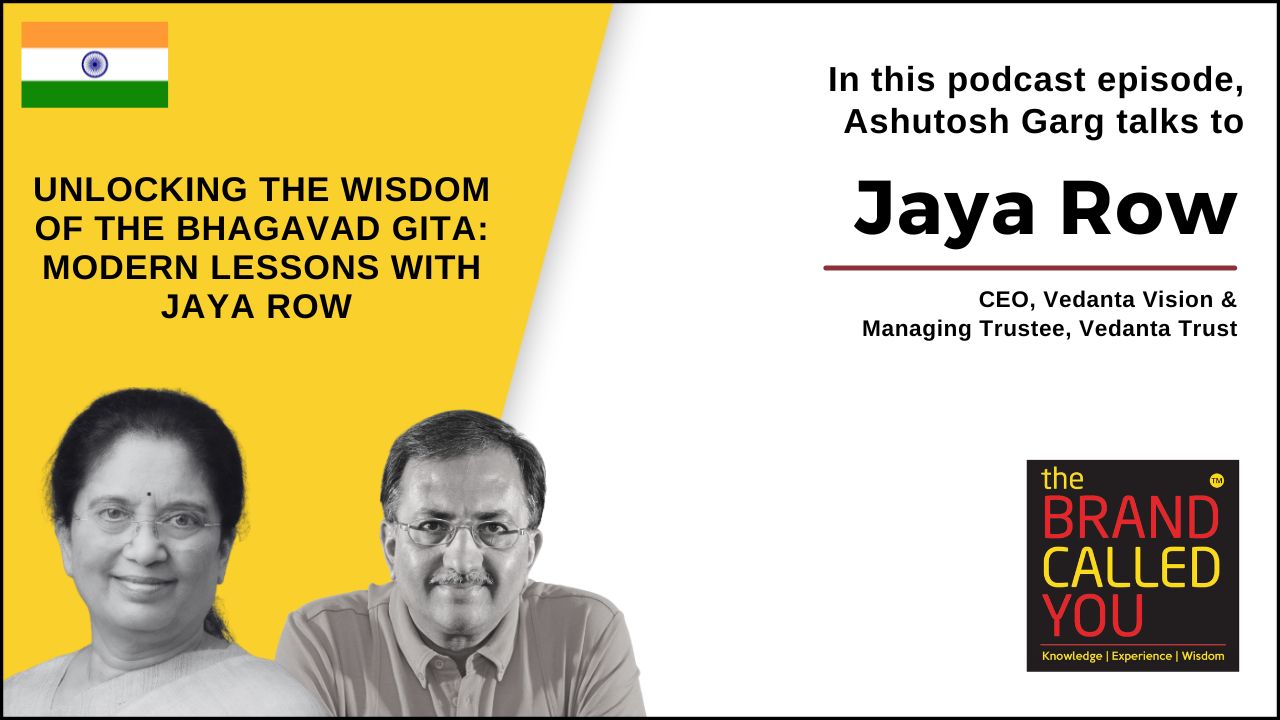
Jaya Row, CEO of Vedanta Vision, on the Timeless Teachings of the Bhagavad Gita
- Sat Chit Anand is our true nature—pure existence, consciousness, and bliss.
- Suffering arises because we are unaware of our true self.
Podcast
Podcast: Play in new window | Download
Follow TBCY RSS
Overview
In this enlightening episode of The Brand Called You, Jaya Row, CEO of Vedanta Vision and Managing Trustee of Vedanta Trust, joins Ashutosh Garg to explore the timeless wisdom of Vedanta and the Bhagavad Gita. Their conversation delves into the core concepts of self-realization, ego, karma, dharma, and their relevance in today’s fast-changing world. Below is a breakdown of the episode with key questions, timestamps, and the most profound takeaways.
00:51 – Why Do We Suffer If Our True Nature Is Bliss?
- Sat Chit Anand is our true nature—pure existence, consciousness, and bliss.
- Suffering arises because we are unaware of our true self.
- This inner void gives rise to desires, as we seek fulfillment through external pursuits.
- Lasting happiness comes from self-knowledge, not from external achievements or possessions.
02:20 – What’s the Biggest Obstacle to Self-Realization?
- The greatest obstacle is not ignorance or fear but becoming acclimatized to sorrow.
- Just as people can become accustomed to living in slums, we can become comfortable in our own “spiritual slums.”
- Plato’s Allegory of the Cave illustrates how people often resist accepting a reality beyond their current experience.
05:08 – Vedantic View of the Ego: Destroy It or Understand It?
- The ego is not something to be destroyed but to be understood.
- Like a bubble in the ocean, the ego is made of the same essence as the ocean itself.
- The ego arises from identifying with name and form (nama-rupa).
- It expresses itself through comparison, separation, and domination, while true knowledge reveals the oneness of all existence.
08:43 – Why Does Arjuna’s Emotional Breakdown Begin the Bhagavad Gita?
- Spiritual awakening often begins with a breakdown rather than enlightenment.
- The scriptures describe four kinds of seekers, and many begin their spiritual journey during times of distress.
- Arjuna’s grief becomes the catalyst for self-discovery and transformation.
10:19 – Why Is Self-Knowledge the Ultimate Solution to Human Problems?
- A teacher must first meet the student at their current level of understanding before guiding them to higher truths.
- Krishna alternates between practical guidance and profound spiritual wisdom.
- The Bhagavad Gita presents self-knowledge as the highest remedy for suffering, confusion, and inner conflict.
12:31 – Does the Gita Teach Detachment from Outcomes or Emotional Dependence on Outcomes?
- The Gita teaches both.
- Focus on performing the right action, knowing that outcomes are never entirely within your control.
- What you can control are your intentions, attitude, and present actions.
- Freedom comes from giving your best effort while letting go of anxiety about the results.
15:39 – What Does Krishna’s Approach to Arjuna’s Problems Teach Us About Handling Our Own Challenges?
- Krishna does not solve Arjuna’s problems for him—he transforms Arjuna’s understanding.
- We cannot change other people; we can only share knowledge and allow them to make their own choices.
- Lasting transformation comes from an inner shift in perspective, not from external intervention.
17:45 – Why Is the Mind Described as Both a Friend and an Enemy?
- The mind becomes our greatest ally when it is guided by the intellect (buddhi).
- Without the guidance of the intellect, the mind easily succumbs to temptation and instant gratification.
- Mastering the mind is the foundation of self-mastery.
18:49 – Why Does the Gita Emphasize Mastering Desires Rather Than Fulfilling Them?
- Desire can never be fully satisfied—fulfilling one desire only gives rise to many more.
- Like fire, desire grows stronger the more it is fed.
- The solution is to rise above desire by focusing on a higher purpose and nobler ideals.
21:40 – How Does One Discover One’s Dharma in the Modern World?
- Dharma encompasses duty, ethics, and, most importantly, one’s unique purpose.
- Discovering your dharma begins with looking within and recognizing what consistently inspires and energizes you.
- Regular introspection and moments of solitude help bring greater clarity to one’s purpose.
24:46 – Can Dharma Conflict with Personal Happiness?
- When you pursue your highest purpose, lesser desires naturally begin to fade.
- If lower desires persist, they can be addressed in moderation without losing sight of your higher goal.
- Maintaining this balance leads to both meaningful achievement and personal fulfillment.
RESOURCES:
Learn more about Jaya Row: LinkedIn
Enjoyed this podcast?
Detach from Outcomes, Not from Effort
One of the Bhagavad Gita’s most profound teachings reminds us:
“You have the right to action alone, never to its fruits.”
Give your best to the present moment, and let go of emotional dependence on the outcome. While results are never fully within our control, our effort, attitude, and intention always are.
Share your thoughts in the comments and help spread these timeless insights throughout your network.
Would you love to give us 5 stars? ⭐⭐⭐⭐⭐ If yes, we’d greatly appreciate your review. Help us reach more people as we bring conversations with leaders, high achievers, and thought leaders from diverse backgrounds and nationalities. Excellence can come from anywhere. Stay informed and hear from emerging achievers and experts from around the world.
Stay updated with what’s shaping the world today through the latest The Brand Called You Podcast episode. Follow us on iTunes, Spotify, and Anchor.fm.
You can find us at:
Website: www.tbcy.in
Instagram: http://bit.ly/3HO7N06
Facebook:http://bit.ly/3YzJOaD
Twitter: http://bit.ly/3wMBOXK
LinkedIn: https://www.linkedin.com/company/tbcy/
YouTube: http://bit.ly/3jmBqfq
Chingari: https://chingari.io/tbcypodcast
Josh: http://bit.ly/3WWP0nB
Thanks for listening!
Profile
- Jaya Row is the CEO of Vedanta Vision and the Managing Trustee of the Vedanta Trust, dedicated to spreading the wisdom of Vedanta.
- A renowned teacher of Vedanta and the Bhagavad Gita, she makes timeless spiritual principles accessible and relevant to modern life.
- Jaya’s teachings focus on self-realization, karma, dharma, emotional intelligence, and the practical application of ancient wisdom to leadership and everyday decision-making.

