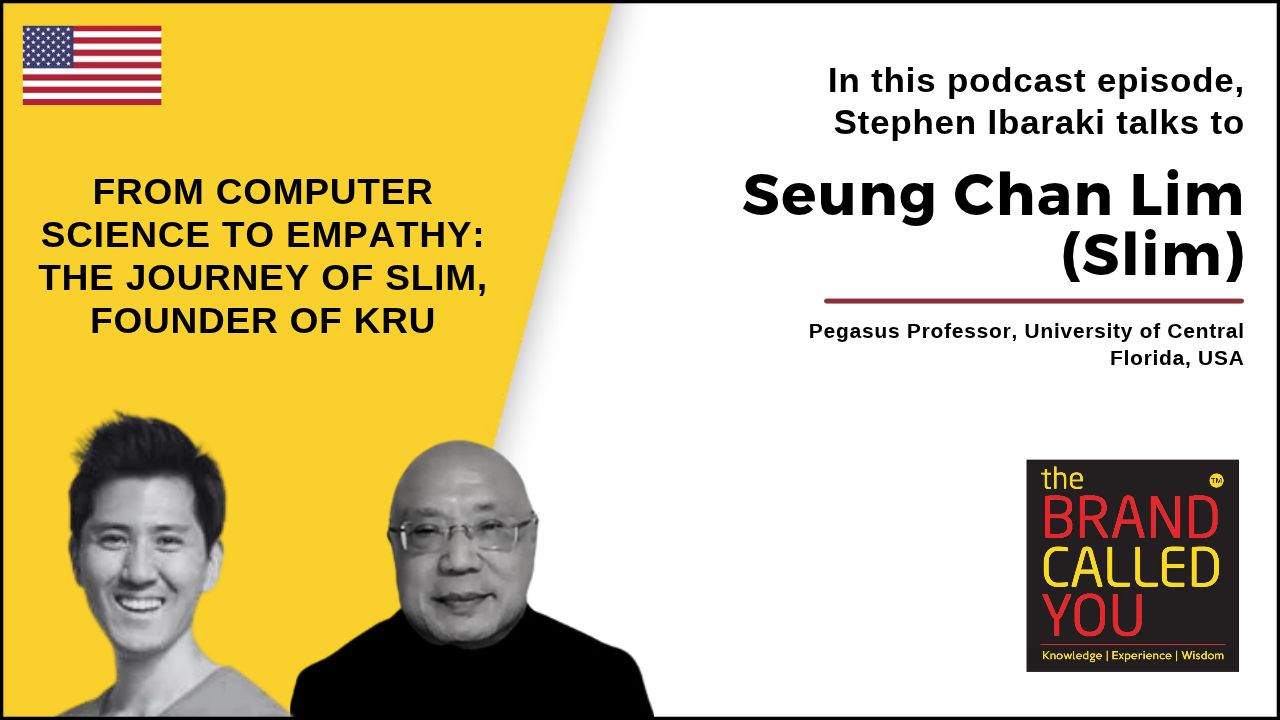
Seung Chan Lim (Slim), Founder of Kru, on Leadership, Creativity, and Human-Centered Innovation
- Moving between countries, navigating cultural differences, and learning to understand diverse perspectives.
- Facing challenges in computer science before meeting Dr. Randy Pausch, whose work helped him discover a deeper interest in technology and virtual worlds.
Podcast
Podcast: Play in new window | Download
Follow TBCY RSS
Overview
In this episode of The Brand Called You (TBCY), the conversation explores the multidimensional journey of Seung Chan Lim, known as Slim—founder of Kru, performance coach, author, designer, and artist.
Slim shares insights from his unconventional path across computer science, fine art, human-centered design, empathy, and leadership coaching. His experiences offer valuable lessons for technology entrepreneurs, creative professionals, and leaders seeking to understand people and drive meaningful innovation.
01:07 – What defining moments shaped Slim’s life and identity?
- Moving between countries, navigating cultural differences, and learning to understand diverse perspectives.
- Facing challenges in computer science before meeting Dr. Randy Pausch, whose work helped him discover a deeper interest in technology and virtual worlds.
- Taking a transformative leap into fine art after receiving advice from a mentor and exploring the relationship between technology, creativity, and traditional artistic practices.
08:12 – Why did Slim choose computer science? Was it cultural, personal, or accidental?
- Finding comfort in mathematics because it offered certainty and the satisfaction of solving problems.
- Developing a love for video games that shaped his initial understanding of computer science.
- Discovering that studying computer science at university involved much more than he had initially expected.
12:41 – What is Maya Design, and how did Slim bridge technology and human-centered design?
- Exploring the MAYA principle—“Most Advanced Yet Acceptable”—which balances technological advancement with human familiarity and usability.
- Examining Maya Design’s research into information-centricity and its challenge to conventional approaches to files and applications.
- Understanding how Maya’s consulting work helped make complex technologies more accessible to people.
- Bridging research and consulting while contributing to early ideas in reusable web components, low-code composition, and human-computer interaction.
21:27 – How did Slim’s paradox of helping others lead him to art school?
- Recognizing that solution-first approaches were not always effective in personal and professional situations.
- Discovering that trying to fix people or organizations could sometimes make problems worse.
- Responding to a mentor’s challenge by leaving the technology environment to study fine art at the Rhode Island School of Design (RISD), exploring creative processes and empathy.
34:09 – How did Slim translate his research into practice and coaching?
- Publishing Realizing Empathy: An Inquiry into the Meaning of Making in 2013, exploring creative making as a conversation with “the other.”
- Expanding his reach through talks, workshops, awards, and a successful Kickstarter campaign.
- Highlighting the importance of asking questions, observing, experimenting, and engaging with diverse perspectives.
36:34 – How did Slim’s research on empathy evolve into coaching for tech founders and leaders?
- Applying empathy-based practices to personal development, organizational leadership, and founder-CEO challenges.
- Discovering that his ideas resonated with technology founders who had achieved technical success but faced people-related challenges.
- Exploring how a shift in perspective can create an “aha” moment and open up new ways of understanding a problem.
44:46 – What is Kru, and how does it support tech founders?
- Establishing Kru as a curated peer group for technology founder CEOs, focused on candid conversations, strategy, accountability, and mutual support.
- Emphasizing practical business value, a deep understanding of each founder’s context, and technology that creates positive impact.
- Launching the model in Korea, with plans to expand into the United States and build a community that encourages meaningful connections and shared learning among founders.
RESOURCES
Learn more about Seung Chan Lim (Slim) and his work through his LinkedIn profile.
ENJOYED THIS PODCAST?
In this episode, the discussion explores how an influential professor, Dr. Randy Pausch, helped Slim discover a deeper passion for computer science by connecting technology with creativity and the human experience.
Sometimes, the right mentor can help us recognize the connection between our interests, our abilities, and our purpose.
Share your perspective in the comments.
Would you love to give us 5 stars? ⭐⭐⭐⭐⭐ If yes, we’d greatly appreciate your review. Help us reach more people as we bring conversations with leaders, high achievers, and thought leaders from diverse backgrounds and nationalities. Excellence can come from anywhere. Stay informed and hear from emerging achievers and experts from around the world.
Stay updated with what’s shaping the world today through the latest The Brand Called You Podcast episode. Follow us on iTunes, Spotify, and Anchor.fm.
You can find us at:
Website: www.tbcy.in
Instagram: http://bit.ly/3HO7N06
Facebook:http://bit.ly/3YzJOaD
Twitter: http://bit.ly/3wMBOXK
LinkedIn: https://www.linkedin.com/company/tbcy/
YouTube: http://bit.ly/3jmBqfq
Chingari: https://chingari.io/tbcypodcast
Josh: http://bit.ly/3WWP0nB
Thanks for listening!
Profile
-
Seung Chan Lim (Slim) is the Founder of Kru, a performance coach, author, designer, and artist.
-
Brings an unconventional background spanning computer science, fine art, and human-centred design.
-
Focuses on empathy, human connection, and understanding people to drive meaningful innovation.

