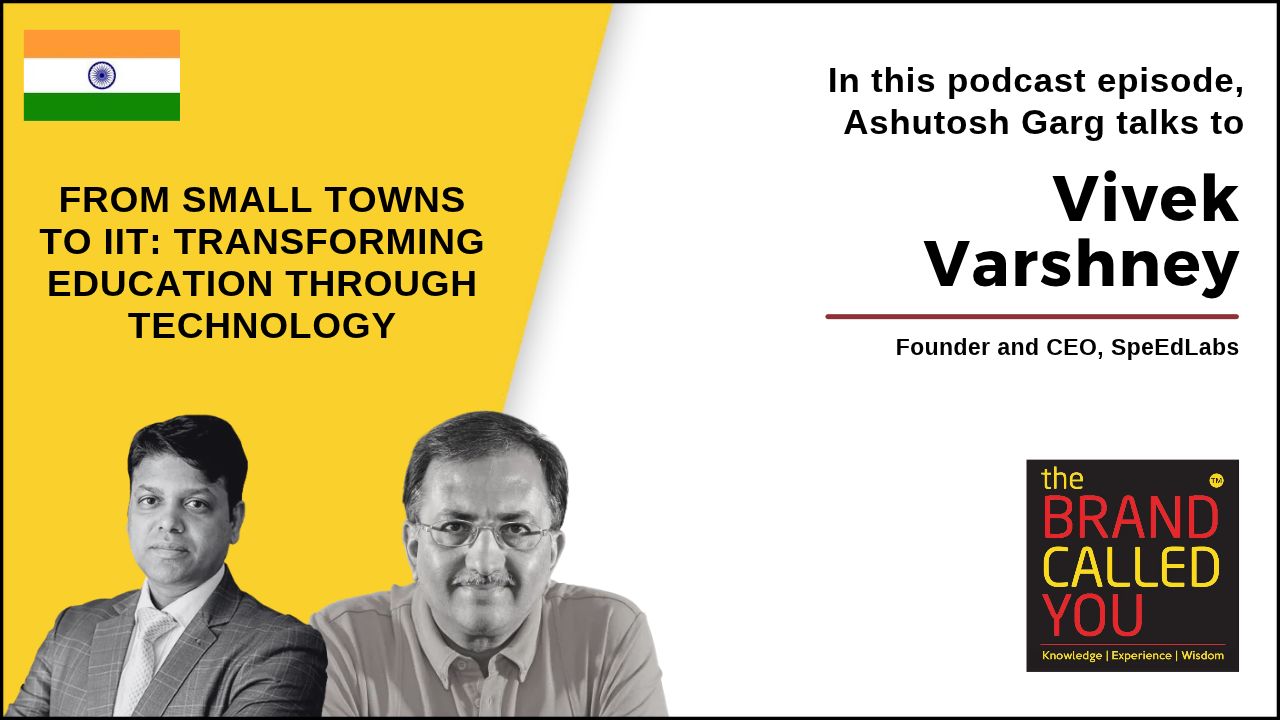
Personalizing Education for India’s Future: Vivek Varshney, Founder & CEO of SpeEdLabs
- Navigating major academic transitions at IIT Kanpur and IIM Lucknow.
- Learning from talented peers and continuously upgrading oneself.
Podcast
Podcast: Play in new window | Download
Follow TBCY RSS
Overview
In this insightful episode of The Brand Called You, host Ashutosh Garg sits down with Vivek Varshney, Founder and CEO of SpeEdLabs, to explore his inspiring journey from a Hindi-medium background to IIT Kanpur and IIM Lucknow.
Vivek shares how his academic experiences, professional journey in finance, and desire to create meaningful societal impact inspired him to enter the education sector and establish SpeEdLabs.
The conversation explores how technology can transform India’s education landscape through personalized learning, adaptive assessments, and measurable student outcomes. It also highlights the challenges faced by students in Tier 2 and Tier 3 cities, including affordability, limited access to experienced teachers, and language barriers.
From understanding why purely digital EdTech models struggled after the pandemic to exploring the role of artificial intelligence in shaping future-ready education, this episode offers valuable insights into the changing dynamics of Indian education.
Here are the key questions and takeaways from the conversation, along with important moments from the podcast.
00:40 | What Was the Hardest Part of Transitioning from a Hindi-Medium Background to IIT Kanpur and IIM Lucknow?
- Navigating major academic transitions at IIT Kanpur and IIM Lucknow.
- Learning from talented peers and continuously upgrading oneself.
- Understanding the value of leading academic institutions and their alumni networks.
02:21 | How Did Early Academic Struggles Shape Your Educational Philosophy and Inspire SpeEdLabs?
- Transitioning from investment banking to pursuing a purpose-driven career.
- Recognizing education as a powerful tool for creating societal impact in India.
- Believing in technology’s potential to transform student learning at scale.
04:06 | What Educational Problems Did You Identify in 2016 That Led to the Founding of SpeEdLabs?
- Recognizing India’s rapid technological and digital transformation.
- Understanding two key determinants of educational outcomes: IQ and how effectively students utilize their available time.
- Exploring technology’s potential to personalize learning and optimize study time.
- Addressing affordability challenges to make personalized education accessible to more students.
06:33 | What Does the Shift from Content Consumption to Measurable Learning Outcomes Look Like in Classrooms?
- Personalizing assignments according to individual student abilities.
- Improving learning outcomes through customized classroom practice.
- Using technology to help every student progress at their own pace.
08:39 | How Do You Persuade Schools to Adopt New Academic Processes?
- Combining traditional teaching methods with adaptive, algorithm-driven practice.
- Integrating technology gradually without disrupting existing school systems.
- Building long-term transformation by initially introducing personalized learning through home practice.
10:30 | What Are the Structural Barriers Faced by Students in Tier 2 Cities?
- Identifying affordability and awareness as two major challenges.
- Addressing the shortage of experienced teachers in smaller cities.
- Overcoming language and English comprehension barriers.
- Simplifying learning materials through accessible language, diagrams, and flowcharts.
13:56 | Why Did Fully Digital EdTech Models Struggle After the Pandemic?
- Understanding the sudden and unnatural shift in learning and content consumption habits.
- Recognizing the importance of human connection and teacher-student engagement.
- Addressing the limitations of purely digital learning for younger students.
- Positioning technology as a support system rather than a replacement for teachers.
16:02 | How Will AI Transform the Way Student Assessments Are Designed and Delivered?
- Using AI to enable hyper-personalized learning and assessments.
- Exploring flexible, choice-driven curricula.
- Encouraging vocational and skill-based education from Grade 9 onwards.
- Making personalized education more affordable and accessible.
RESOURCES
Learn more about Vivek Varshney and his work through his LinkedIn profile.
ENJOYED THIS PODCAST?
A key theme of this conversation is Vivek Varshney’s decision to move beyond a successful finance career and pursue meaningful impact through education.
Driven by the belief that education is one of the most powerful drivers of national growth, Vivek highlights how technology can help millions of students unlock their potential.
Share your thoughts and perspectives in the comments.
Would you love to give us 5 stars? ⭐⭐⭐⭐⭐ If yes, we’d greatly appreciate your review. Help us reach more people as we bring conversations with leaders, high achievers, and thought leaders from diverse backgrounds and nationalities. Excellence can come from anywhere. Stay informed and hear from emerging achievers and experts from around the world.
Stay updated with what’s shaping the world today through the latest The Brand Called You Podcast episode. Follow us on iTunes, Spotify, and Anchor.fm.
You can find us at:
Website: www.tbcy.in
Instagram: http://bit.ly/3HO7N06
Facebook:http://bit.ly/3YzJOaD
Twitter: http://bit.ly/3wMBOXK
LinkedIn: https://www.linkedin.com/company/tbcy/
YouTube: http://bit.ly/3jmBqfq
Chingari: https://chingari.io/tbcypodcast
Josh: http://bit.ly/3WWP0nB
Thanks for listening!
Profile
-
Vivek Varshney is the Founder and CEO of SpeEdLabs, an education technology company focused on transforming learning.
-
Overcame a Hindi-medium educational background to study at IIT Kanpur and IIM Lucknow.
-
Transitioned from a career in finance to entrepreneurship, driven by a passion for creating meaningful social impact through education.

