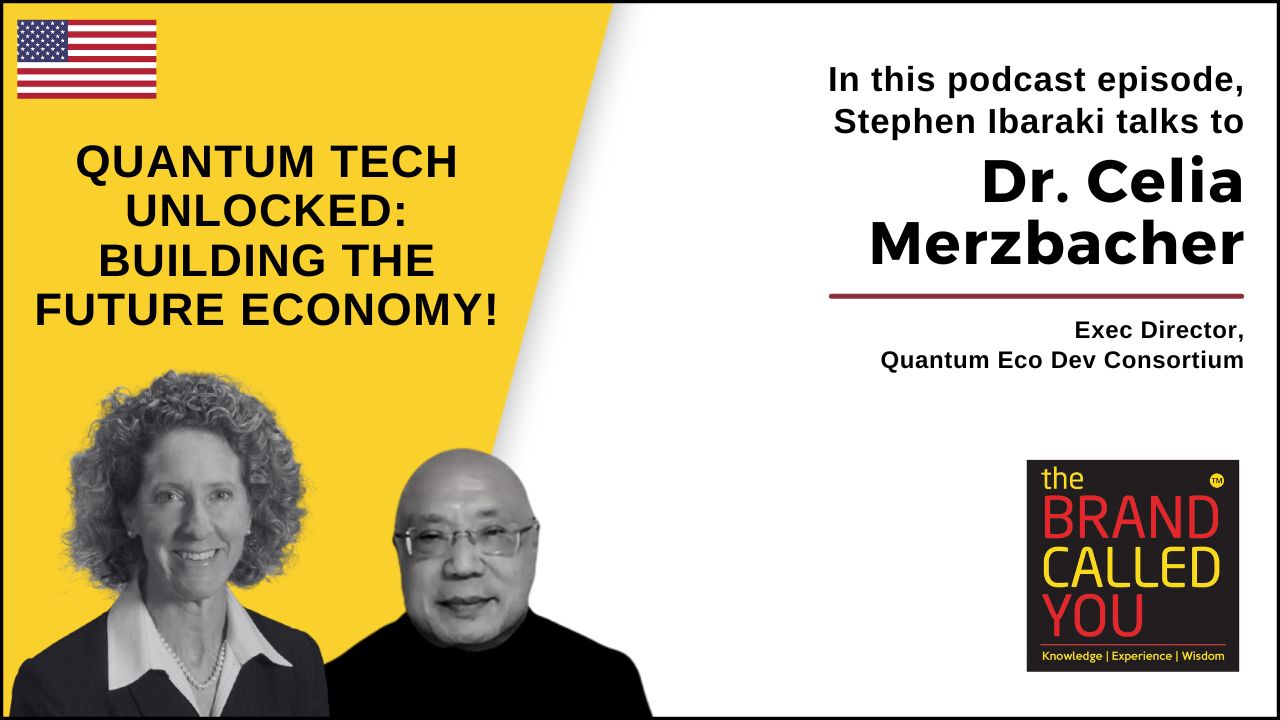
Dr. Celia Merzbacher, Executive Director, Quantum Economic Development Consortium (QED-C)
- Growing up in a STEM-focused household, with parents whose careers were rooted in science and mathematics.
- Beginning her professional journey in geology and mineralogy before expanding into materials science and nanotechnology.
Podcast
Podcast: Play in new window | Download
Follow TBCY RSS
Overview
From her multidisciplinary journey through scientific research, public policy, and industry leadership to the future of quantum computing and post-quantum cybersecurity, this episode offers valuable perspectives for students, researchers, business leaders, policymakers, and anyone curious about the technologies shaping tomorrow.
Below is a comprehensive summary of the discussion, organized by the key themes explored throughout the episode.
01:01 – What Inspired a Career at the Intersection of Science, Policy, and Industry?
- Growing up in a STEM-focused household, with parents whose careers were rooted in science and mathematics.
- Beginning her professional journey in geology and mineralogy before expanding into materials science and nanotechnology.
- Taking on leadership roles across scientific research, federal policy, and industry.
- Building a uniquely multidisciplinary career that spans academia, government, and nonprofit consortium leadership.
07:32-How Has the Quantum Ecosystem Evolved, and What Role Does QED-C Play?
Established following the National Quantum Initiative Act of 2018, the Quantum Economic Development Consortium (QED-C) was created to accelerate commercialization and strengthen collaboration across the quantum ecosystem.
Today, QED-C:
- Brings together more than 250 member organizations from industry, academia, government, and nonprofits.
- Encourages international collaboration and cross-border partnerships.
- Supports the development of a robust quantum supply chain.
- Helps bridge the gap between research breakthroughs and commercial deployment.
Rather than promoting competition alone, QED-C emphasizes ecosystem-wide collaboration to accelerate innovation.
19:33-When Will Quantum Technology Deliver Commercial Value?
The discussion explores how expectations for quantum computing have evolved significantly over the past decade.
Key insights include:
- Earlier estimates suggested cryptographically relevant quantum computers were several decades away.
- Many experts now believe practical breakthroughs could occur before 2033.
- Quantum utility—the point at which quantum computers outperform classical systems for commercially valuable applications—may be achieved within the next decade.
- Advances in error correction, hardware scalability, and hybrid quantum-classical computing continue to accelerate progress.
- Government benchmarking initiatives, including DARPA programs, are helping measure and validate technological milestones.
22:03-Why Is Post-Quantum Cryptography So Important?
Preparing for the post-quantum era is becoming an urgent cybersecurity priority.
Topics discussed include:
- The growing “harvest now, decrypt later” threat, where encrypted data may be stolen today and decrypted by future quantum computers.
- The need to migrate toward quantum-resistant cryptographic standards before current encryption becomes vulnerable.
- The complexity of transitioning legacy infrastructure, including software, firmware, and embedded hardware.
- Federal mandates and executive orders encouraging organizations to inventory cryptographic assets and prioritize migration planning.
- QED-C’s role in connecting organizations with expertise and resources while supporting industry-wide awareness.
37:22-How Does QED-C Support the Global Quantum Community?
QED-C serves as a neutral platform that helps organizations collaborate across the rapidly expanding quantum ecosystem.
Members benefit from:
- A comprehensive directory that connects solution providers, customers, researchers, and collaborators.
- Publications, workshops, technical reports, and market research.
- Working groups focused on workforce development, benchmarking, standards, policy, supply chains, and commercialization.
- Opportunities for startups, established companies, universities, government agencies, and international partners to collaborate effectively.
The consortium remains technology-neutral while encouraging innovation across the entire industry.
RESOURCES:
Learn more about Dr Celia Merzbacher: LinkedIn
Enjoyed this podcast?
The Quantum Economic Development Consortium (QED-C) brings together more than 250 organizations from industry, academia, government, and research institutions to foster collaboration, develop standards, inform policy, strengthen supply chains, and accelerate the growth of the global quantum economy.
If you enjoyed this episode, share your thoughts in the comments and help spread these insights across your network.
Would you love to give us 5 stars? ⭐⭐⭐⭐⭐ If yes, we’d greatly appreciate your review. Help us reach more people as we bring conversations with leaders, high achievers, and thought leaders from diverse backgrounds and nationalities. Excellence can come from anywhere. Stay informed and hear from emerging achievers and experts from around the world.
Stay updated with what’s shaping the world today through the latest The Brand Called You Podcast episode. Follow us on iTunes, Spotify, and Anchor.fm.
You can find us at:
Website: www.tbcy.in
Instagram: http://bit.ly/3HO7N06
Facebook:http://bit.ly/3YzJOaD
Twitter: http://bit.ly/3wMBOXK
LinkedIn: https://www.linkedin.com/company/tbcy/
YouTube: http://bit.ly/3jmBqfq
Chingari: https://chingari.io/tbcypodcast
Josh: http://bit.ly/3WWP0nB
Thanks for listening!
Profile
- Quantum technology leader has built a multidisciplinary career spanning scientific research, public policy, and industry leadership, with a focus on emerging technologies.
- Their expertise includes quantum computing, post-quantum cybersecurity, and the intersection of science, innovation, and policy.
- They are passionate about preparing organizations and governments for the transformative impact of quantum technologies and the security challenges of the post-quantum era.

