
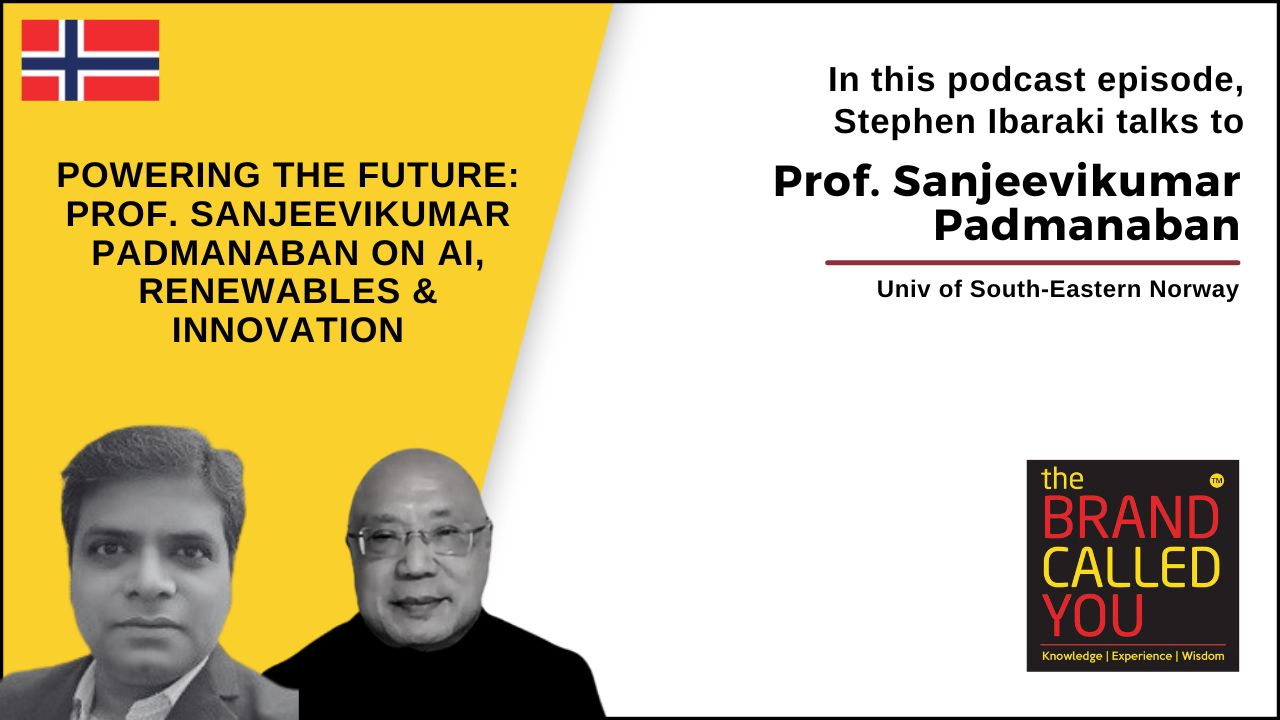
Prof. Sanjeevikumar Padmanaban, Full Professor at the University of South-Eastern Norway
- Family and teachers played a pivotal role in shaping his academic interests despite coming from non-engineering backgrounds.
- A deep passion for mathematics laid the foundation for his journey into electrical engineering.
Podcast
Podcast: Play in new window | Download
Follow TBCY RSS
Overview
Get inspired by the remarkable journey of Prof. Sanjeevikumar Padmanaban, a leading figure in electrical power engineering and renewable energy. In this episode, he shares the pivotal moments that shaped his career, his groundbreaking research, and his vision for the future of power electronics, renewable energy, and AI integration. Below, we highlight key moments from the conversation with clickable timestamps.
01:15 – What Were Your Early Influences and Career-Defining Moments?
- Family and teachers played a pivotal role in shaping his academic interests despite coming from non-engineering backgrounds.
- A deep passion for mathematics laid the foundation for his journey into electrical engineering.
- Influential professors and mentors from India, Europe, and the United States, along with their books and guidance, significantly shaped his academic and research career.
08:16 – What Was Your Path After Earning a PhD?
- Focused on building a career as a professor and researcher in power electronics.
- Began his academic career as an Associate Professor at Vellore Institute of Technology (VIT), India.
- Established advanced, industry-oriented research laboratories in collaboration with global companies, including Rockwell Automation.
- Expanded his academic and research experience through positions in South Africa, Denmark (Aalborg University), and the University of South-Eastern Norway.
18:29 – What Are the Latest Trends in Power Electronics and Renewable Energy Research?
- Advanced semiconductor materials such as silicon carbide (SiC) and gallium nitride (GaN) are improving the efficiency, reliability, and power density of modern power electronics.
- Artificial intelligence (AI) is enabling smarter control, optimization, and automation of renewable energy and power electronic systems.
- Growing interest in energy storage technologies, including solid-state batteries and supercapacitors, is accelerating the transition to cleaner energy.
- AI-powered controllers and optimization algorithms are supporting the large-scale integration of renewable energy into modern power grids.
23:24 – What Innovative Materials and Technologies Are Being Explored?
- Research into solid-state batteries aims to enable safer, higher-capacity, and longer-lasting energy storage, although the technology is still in its early stages.
- Supercapacitors are being explored for applications in offshore wind energy and green hydrogen production.
- Collaborative projects with Dash Dynamics are advancing wireless power transfer technologies for electric vehicle charging and smart grid monitoring.
- Researchers are also investigating alternative battery chemistries, including sodium-based technologies, to improve future energy storage solutions.
28:18 – How Is AI Being Applied to Renewable Energy Systems?
- AI techniques such as neural networks, fuzzy logic, particle swarm optimization, and genetic algorithms are enhancing renewable energy control systems.
- Customized AI models are being developed for applications involving wind turbines, battery management systems, and photovoltaic (PV) systems.
- Multi-AI architectures are improving system reliability through redundancy and intelligent decision-making.
- Emerging AI approaches are making electrical grids more predictive, adaptive, and resilient while helping prevent large-scale blackouts.
31:17 – What Does the Future Hold?
- Decentralized renewable energy systems could enable households to become energy producers and entrepreneurs.
- AI and power electronics will play a critical role in energy trading, load shifting, and intelligent energy management.
- Vehicle-to-grid (V2G) technologies are expected to leverage billions of electric vehicle batteries as distributed energy resources.
- Future power grids will become increasingly flexible, decentralized, and consumer-driven.
34:06 – Which Countries Are Leading the Clean Energy Transition?
- Nordic countries—including Norway, Denmark, and Sweden—lead the world in clean energy adoption and electric vehicle infrastructure.
- China continues to drive innovation in semiconductor manufacturing and next-generation battery technologies.
- Europe and Asia are rapidly advancing renewable energy integration through supportive infrastructure, investment, and policy development.
RESOURCES:
Learn more about Prof Sanjeevikumar Padmanaban: LinkedIn
Enjoyed this podcast?
How do you see power electronics transforming data centers, renewable energy, and everyday life by 2030? What challenges and opportunities do you foresee?
Share your thoughts in the comments and help spread these insights across your network.
Would you love to give us 5 stars? ⭐⭐⭐⭐⭐ If yes, we’d greatly appreciate your review. Help us reach more people as we bring conversations with leaders, high achievers, and thought leaders from diverse backgrounds and nationalities. Excellence can come from anywhere. Stay informed and hear from emerging achievers and experts from around the world.
Stay updated with what’s shaping the world today through the latest The Brand Called You Podcast episode. Follow us on iTunes, Spotify, and Anchor.fm.
You can find us at:
Website: www.tbcy.in
Instagram: http://bit.ly/3HO7N06
Facebook:http://bit.ly/3YzJOaD
Twitter: http://bit.ly/3wMBOXK
LinkedIn: https://www.linkedin.com/company/tbcy/
YouTube: http://bit.ly/3jmBqfq
Chingari: https://chingari.io/tbcypodcast
Josh: http://bit.ly/3WWP0nB
Thanks for listening!
Profile
- Sanjeevikumar Padmanaban is a distinguished professor and researcher specializing in electrical power engineering, power electronics, and renewable energy systems.
- His pioneering research focuses on integrating advanced power technologies, smart grids, artificial intelligence, and sustainable energy solutions.
- With an extensive academic and research career, he has contributed significantly to innovation in renewable energy, electric mobility, and next-generation power systems.

