
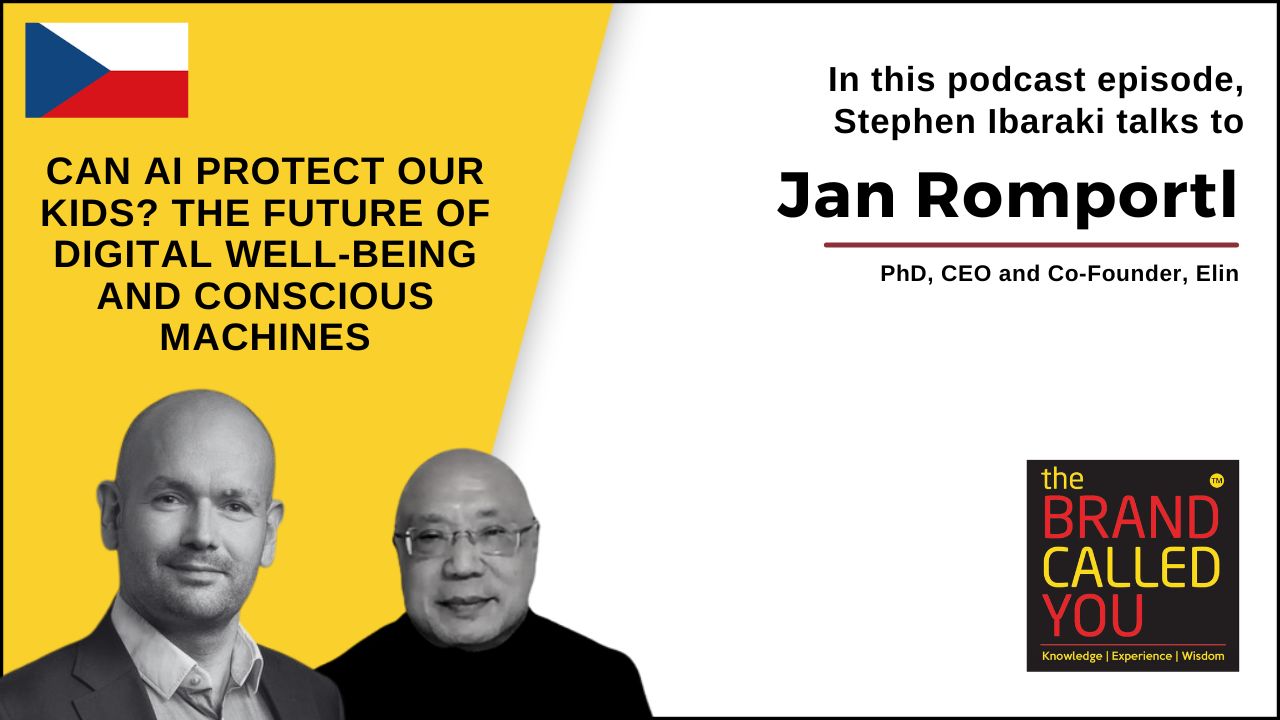
Jan Romportl, PhD, CEO & Co-Founder of Elin.aiUnlocking AI and Digital Well-Being: Jan Romportl, PhD, CEO & Co-Founder of Elin.ai
- Receiving an Atari 800 XL at the age of 11 sparked a lifelong passion for programming and artificial intelligence.
- A fascination with both language and AI developed early, driven by curiosity about whether machines could truly replicate human cognition.
Podcast
Podcast: Play in new window | Download
Follow TBCY RSS
Overview
In this fascinating episode of the TBCY Podcast, Stephen Ibaraki speaks with Jan Romportl, PhD, CEO & Co-Founder of Elin.ai, about his remarkable journey from an early fascination with programming to becoming a leading voice in artificial intelligence, digital well-being, and the philosophy of machine consciousness. The conversation spans personal milestones, the ethical frontiers of AI, the development of cognitive antivirus technology for youth, and the future of Artificial General Intelligence (AGI).
Below are the key questions explored throughout the episode, along with the major insights discussed.
02:30- What early experiences shaped Jan Romportl’s passion for AI and interdisciplinary research?
- Receiving an Atari 800 XL at the age of 11 sparked a lifelong passion for programming and artificial intelligence.
- A fascination with both language and AI developed early, driven by curiosity about whether machines could truly replicate human cognition.
- Growing up in a research-oriented family environment nurtured scientific curiosity and ambition.
- Science fiction played a significant role in inspiring long-term interests in technology and the future of intelligence.
13:00-How did Jan bridge the gap between academia and real-world AI applications?
- Jan reflects on his academic career, including research in speech recognition and applied linguistics.
- He discusses his transition from university research to serving as Chief Data Scientist at O2, where he leveraged large-scale data to solve practical business problems.
- The conversation highlights the contrast between academia’s research focus and industry’s ability to deliver real-world impact through greater resources and implementation opportunities.
- AI-driven initiatives in healthcare, mental health, and bioinformatics—including cancer research—demonstrate the breadth of interdisciplinary innovation.
23:22-What inspired the creation of Elin.ai, and what problem does it solve?
- The concept of a “cognitive antivirus” emerged as a way to protect children from the harmful effects of social media algorithms.
- Jan collaborated with leading neuroscientists to develop AI-powered digital well-being solutions.
- Elin.ai monitors a child’s cognitive load and digital well-being across social platforms, helping identify potentially harmful content while providing parents with meaningful insights.
- The discussion also covers the product’s evolution, early adoption across Europe, and its long-term vision for global expansion. (37:35)
28:43-How does Jan Romportl view the relationship between AI capability and consciousness?
- Jan distinguishes between AI capability (what AI systems can do) and consciousness (subjective experience).
- The conversation references philosophical and scientific perspectives, including Roger Penrose’s theories and Integrated Information Theory, while acknowledging the challenges of empirically verifying machine consciousness.
- The discussion explores whether increasingly sophisticated language models could eventually evolve into temporally aware systems with characteristics resembling consciousness.
- Jan also cautions against prematurely attributing consciousness to machines—or even animals—and discusses the growing risks of parasocial relationships with both AI systems and online personalities, particularly among young people. (36:47)
44:58-What threats and opportunities exist in deploying cognitive antivirus technology?
- Cognitive antivirus is compared to the evolution of traditional antivirus software, highlighting the need for cognitive protection as a foundational layer of future digital infrastructure.
- Strategic growth plans include B2B partnerships with telecommunications companies, banks, and major technology firms such as Google and Microsoft.
- The conversation also emphasizes the importance of educating parents while navigating the challenge of introducing an entirely new technology category before widespread market awareness exists.
RESOURCES:
Learn more about Jan Romportl: LinkedIn
Enjoyed this podcast?
One of Jan’s key recommendations was clear: parents should delay their children’s exposure to smartphones and social media for as long as possible while remaining actively involved in their digital lives. He also emphasized the importance of paying attention to the growing influence of parasocial relationships—not only with online personalities but also with AI agents.
Share your thoughts in the comments and help spread these valuable insights throughout your network.
Would you love to give us 5 stars? ⭐⭐⭐⭐⭐ If yes, we’d greatly appreciate your review. Help us reach more people as we bring conversations with leaders, high achievers, and thought leaders from diverse backgrounds and nationalities. Excellence can come from anywhere. Stay informed and hear from emerging achievers and experts from around the world.
Stay updated with what’s shaping the world today through the latest The Brand Called You Podcast episode. Follow us on iTunes, Spotify, and Anchor.fm.
You can find us at:
Website: www.tbcy.in
Instagram: http://bit.ly/3HO7N06
Facebook:http://bit.ly/3YzJOaD
Twitter: http://bit.ly/3wMBOXK
LinkedIn: https://www.linkedin.com/company/tbcy/
YouTube: http://bit.ly/3jmBqfq
Chingari: https://chingari.io/tbcypodcast
Josh: http://bit.ly/3WWP0nB
Thanks for listening!
Profile
- Jan Romportl is the CEO and Co-Founder of Elin.ai, where he focuses on advancing responsible and human-centered AI.
- With a background in artificial intelligence, cognitive science, and philosophy, he explores topics including machine consciousness, Artificial General Intelligence (AGI), and AI ethics.
- Jan is a strong advocate for digital well-being and has contributed to developing cognitive antivirus technologies designed to help protect young people in the digital age.

