
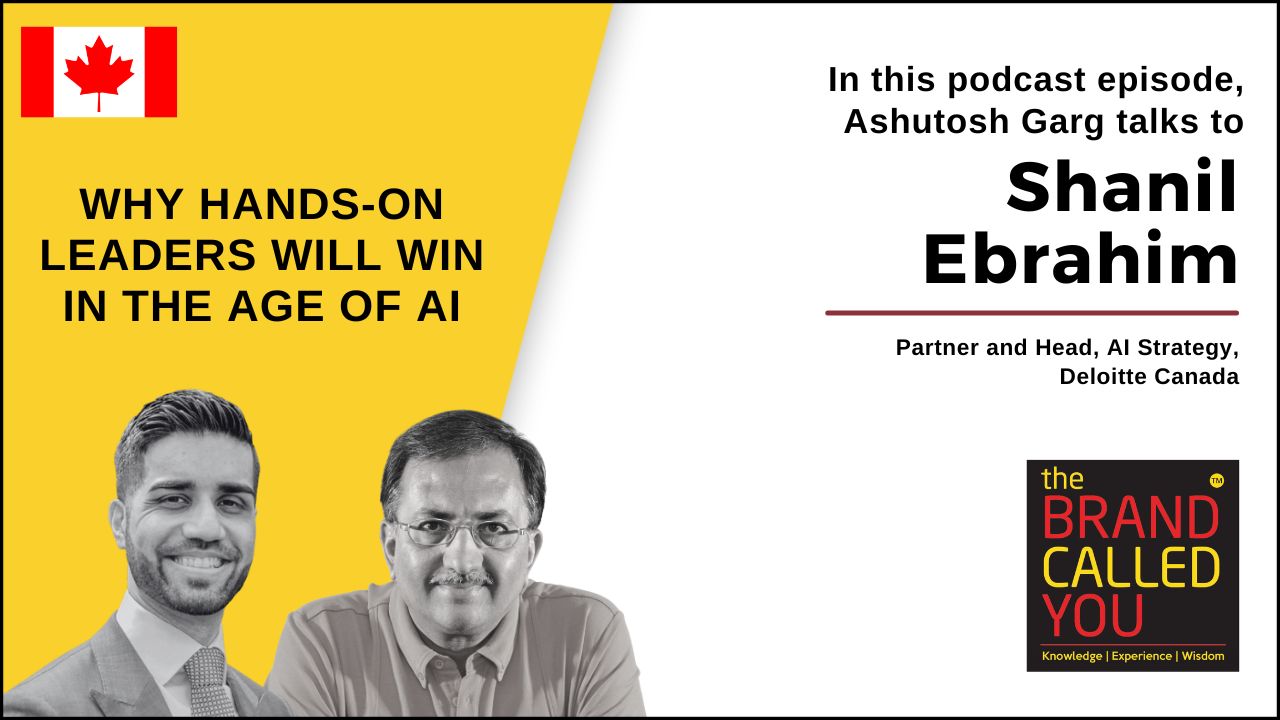
Shanil Ebrahim, Partner & Head of AI Strategy, Deloitte Canada
- AI strategy is not just about adopting tools or running pilot projects.
- It begins by identifying where the business is stuck and which real problems need to be solved.
Podcast
Podcast: Play in new window | Download
Follow TBCY RSS
Overview
In this insightful episode of The Brand Called You, Shanil Ebrahim, Partner and Head of AI Strategy at Deloitte Canada, returns to discuss what separates effective AI leadership and strategy from organizations that are simply experimenting. Drawing on practical examples and deep industry experience, Shanil explains the realities of scaling AI, the vital role of hands-on leadership, and how AI is transforming organizational design and decision-making. Key highlights from the conversation are outlined below.
00:41 – What defines an effective AI strategy in today’s changing business world?
- AI strategy is not just about adopting tools or running pilot projects.
- It begins by identifying where the business is stuck and which real problems need to be solved.
- Success is measured by improvements in speed, intelligence, efficiency, or customer value.
- AI delivers its greatest impact when it is connected to meaningful business outcomes.
02:38 – What separates organizations that scale AI successfully from those stuck in pilot mode?
- The difference lies in treating AI as a business transformation rather than a technology experiment.
- Successful organizations focus on ownership of outcomes, redesigning workflows, and measuring value with discipline.
- Amazon integrates AI deeply across operational domains, enabling cross-functional synergies.
- Real transformation happens when AI reshapes the operating system of the business.
04:38 – Why does the future belong to hands-on leaders?
- Leadership must move beyond reviewing presentations and approving budgets.
- Leaders need to use and challenge AI tools themselves to develop a deeper understanding.
- Satya Nadella actively engages with AI tools at Microsoft, setting an example of hands-on leadership.
- Detached leadership is a costly risk in the AI era.
06:09 – How is agentic AI changing executive and senior leadership roles?
- Agentic AI shifts the focus from generating insights to taking automated actions.
- It requires leaders to define clear boundaries: what AI can decide and what requires human approval.
- Leadership is evolving from supervision to designing effective human-AI collaboration.
07:44 – How should leaders balance AI automation with human judgment?
- Leaders must move beyond the comfort phrase “human in the loop.”
- AI should handle repetitive and information-intensive tasks, while humans remain responsible for high-risk or ambiguous decisions.
- The Mayo Clinic uses AI to support routine tasks while maintaining human oversight for critical decisions.
09:14 – What are the biggest mistakes in enterprise AI strategies?
- Starting with technology instead of the business problem.
- Spreading AI investments too thin across multiple use cases.
- Failing to redesign the operating model and organizational workflows to support AI.
11:24 – Why is “I’m not technical” a dangerous mindset for leaders?
- This mindset allows leaders to disengage from AI’s growing business impact.
- Leaders must develop enough technical fluency to evaluate AI’s capabilities, risks, and business implications.
- In today’s environment, it is as unacceptable as not understanding basic finance or customer needs.
12:59 – How crucial are data governance and compliance in building scalable AI platforms?
- Governance is foundational—trusted data and clear permissions are essential for scaling AI.
- Weak governance slows progress and introduces unnecessary risk.
- JPMorganChase treats AI and data governance as an enterprise-wide priority rather than simply an IT responsibility.
14:25 – How will AI reshape organizational structures and decision-making hierarchies?
- AI will eliminate the need for some management layers as information flows more freely across organizations.
- More decisions will shift to frontline teams empowered by AI-driven insights.
- Companies such as Uber and Netflix demonstrate how flatter structures enable faster, data-driven decision-making.
RESOURCES:
Learn more about Shanil Ebrahim: LinkedIn
Enjoyed this podcast?
It’s no longer just about getting insights—it’s about enabling machines to take action. Executives must define clear boundaries around what AI can execute, recommend, and never automate. Decision-making is evolving from humans vs. AI to humans working with AI.
Share your thoughts in the comments and help spread these insights across your network.
Would you love to give us 5 stars? ⭐⭐⭐⭐⭐ If yes, we’d greatly appreciate your review. Help us reach more people as we bring conversations with leaders, high achievers, and thought leaders from diverse backgrounds and nationalities. Excellence can come from anywhere. Stay informed and hear from emerging achievers and experts from around the world.
Stay updated with what’s shaping the world today through the latest The Brand Called You Podcast episode. Follow us on iTunes, Spotify, and Anchor.fm.
You can find us at:
Website: www.tbcy.in
Instagram: http://bit.ly/3HO7N06
Facebook:http://bit.ly/3YzJOaD
Twitter: http://bit.ly/3wMBOXK
LinkedIn: https://www.linkedin.com/company/tbcy/
YouTube: http://bit.ly/3jmBqfq
Chingari: https://chingari.io/tbcypodcast
Josh: http://bit.ly/3WWP0nB
Thanks for listening!
Profile
- Shanil Ebrahim is the Partner and Head of AI Strategy at Deloitte Canada, helping organizations develop and scale enterprise AI initiatives.
- He specializes in AI strategy, digital transformation, and guiding leaders from AI experimentation to organization-wide adoption and measurable business impact.
- Shanil emphasizes the importance of hands-on leadership, responsible AI governance, and aligning AI initiatives with business objectives and organizational capabilities.

