
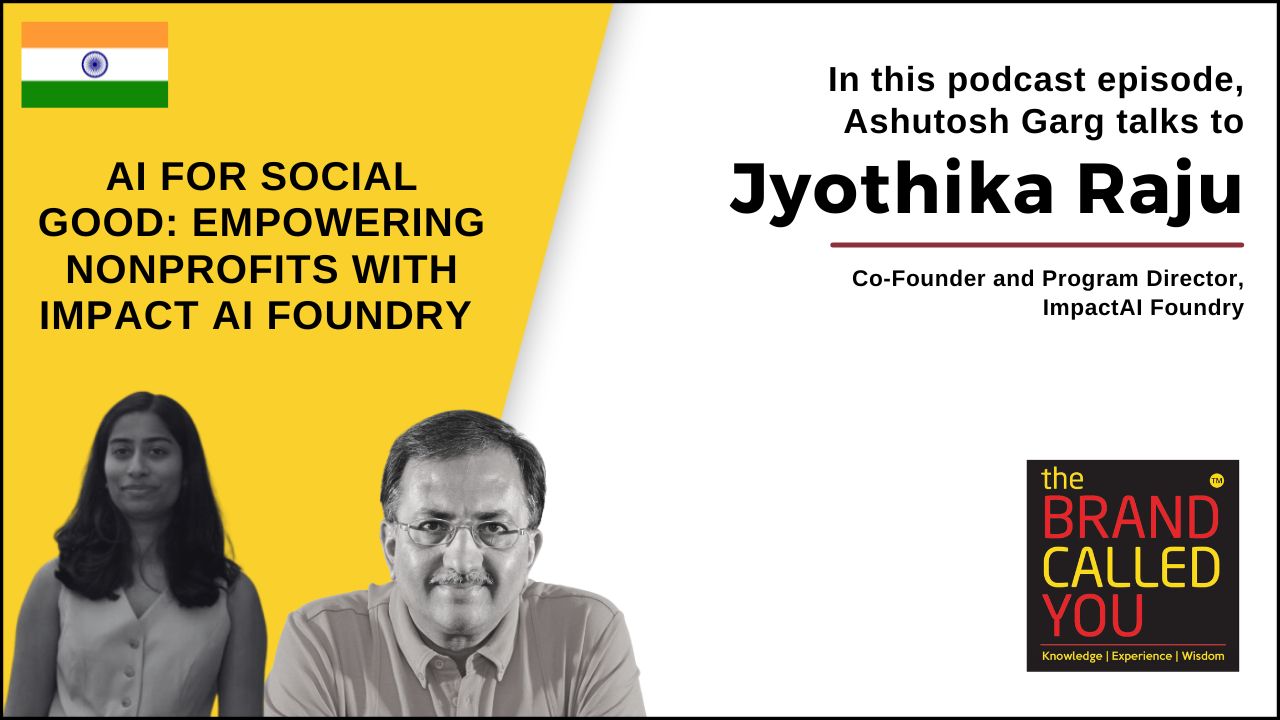
Jyothika Raju, Co-Founder & Program Director, ImpactAI Foundry
- Growing up in Bengaluru and being exposed to an engineering-driven culture
- Early interest in computer science and technology
Podcast
Podcast: Play in new window | Download
Follow TBCY RSS
Overview
In this insightful episode of The Brand Called You, Jyothika Raju, Co-Founder and Program Director of ImpactAI Foundry, joins Ashutosh Garg to discuss her journey at the intersection of technology, policy, and social impact, and how she is empowering nonprofits to adopt AI responsibly.
00:44 – What sparked Jyothika Raju’s interest in technology, public policy, and social impact?
- Growing up in Bengaluru and being exposed to an engineering-driven culture
- Early interest in computer science and technology
- Volunteering with NGOs and community initiatives
- A desire to combine technology with public policy to create meaningful social impact
02:54 – How does Jyothika Raju define responsible and accountable AI?
- The rapid rise of AI tools such as ChatGPT and Claude has made AI an essential part of today’s technology landscape.
- Recognizing challenges such as bias in AI models and algorithms
- Three key principles of responsible AI:
- Honest representation of stakeholder communities
- Honest evaluation of AI capabilities and limitations
- Human-in-the-loop accountability, especially for vulnerable communities
06:12 – What did Jyothika Raju’s AI governance research reveal about the opportunities and risks of AI?
Opportunities
- AI can make technology more accessible for NGOs with limited resources.
- It enables non-technical users to build websites, automate workflows, and improve operational efficiency.
Risks
- Bias and accessibility challenges persist, particularly in the Global South.
- Many AI models are designed primarily for Eurocentric contexts, overlooking linguistic and cultural diversity.
- Deliberate action is required to ensure AI does not deepen existing inequalities.
07:56 – What lessons from the sustainability sector influence AI policy?
- Experience in renewable energy highlighted the importance of understanding community impact before implementing large-scale projects.
- Similar precautionary and proactive approaches are needed in AI policy.
- AI data centres require significant energy resources and can have substantial local impacts, particularly in the Global South.
- Technology adoption should be guided by thoughtful regulation and community engagement.
10:08 – What is ImpactAI Foundry, and what gap does it address?
- A two-month capacity-building program that helps NGOs adopt AI in practical and sustainable ways
- NGOs are paired with engineers in Bengaluru who mentor them rather than simply building solutions on their behalf.
- The goal is to enable nonprofits to build, own, and continuously improve their own AI solutions.
- The program addresses gaps in funding, technical capacity, AI knowledge, and long-term talent development.
12:57 – What are the main challenges nonprofits face in adopting AI?
- Limited funding and resources often mean nonprofits prioritize frontline work over AI training and technology adoption.
- A shortage of skilled technical talent and long-term engineering partnerships makes sustainable AI implementation difficult.
- Protecting sensitive data and maintaining the privacy of vulnerable communities are critical concerns.
- Building trust through responsible data stewardship and ethical AI practices is essential.
15:06 – What are some examples of AI tools developed through the program?
- Adaptive learning platforms that personalize educational content based on student responses
- AI-powered automation for administrative tasks and grant management
- Accessible data dashboards that help organizations analyze and act on field data
- Multilingual chatbots and other customized AI solutions designed to meet the specific needs of nonprofits
16:46 – How does ImpactAI Foundry ensure AI solutions are ethical, transparent, and useful?
- Every project begins with understanding organizational workflows rather than introducing technology for its own sake.
- The team continually evaluates whether AI genuinely saves time, money, or resources.
- Strong emphasis is placed on understanding stakeholders, responsible data use, and ethical implementation.
- The ultimate goal is to help nonprofits become self-sufficient rather than dependent on external technical support.
Learn more about Jyothika Raju: LinkedIn
Enjoyed this podcast?
It’s not enough to build AI. As Jyothika Raju explains, the real questions are: Who is building these AI tools? Who benefits from them? And are we unintentionally reinforcing existing biases? AI’s true potential lies in creating solutions that serve everyone—not just a privileged few.
Share your thoughts in the comments and help spread these insights across your network.
Would you love to give us 5 stars? ⭐⭐⭐⭐⭐ If yes, we’d greatly appreciate your review. Help us reach more people as we bring conversations with leaders, high achievers, and thought leaders from diverse backgrounds and nationalities. Excellence can come from anywhere. Stay informed and hear from emerging achievers and experts from around the world.
Stay updated with what’s shaping the world today through the latest The Brand Called You Podcast episode. Follow us on iTunes, Spotify, and Anchor.fm.
You can find us at:
Website: www.tbcy.in
Instagram: http://bit.ly/3HO7N06
Facebook:http://bit.ly/3YzJOaD
Twitter: http://bit.ly/3wMBOXK
LinkedIn: https://www.linkedin.com/company/tbcy/
YouTube: http://bit.ly/3jmBqfq
Chingari: https://chingari.io/tbcypodcast
Josh: http://bit.ly/3WWP0nB
Thanks for listening!
Profile
- Jyothika Raju is the Co-Founder and Program Director of ImpactAI Foundry, helping nonprofits harness AI for greater impact.
- She works at the intersection of technology, public policy, and social innovation, promoting responsible and ethical AI adoption across the nonprofit sector.
- Jyothika is passionate about building AI literacy, strengthening organizational capacity, and ensuring that emerging technologies address real community needs.

