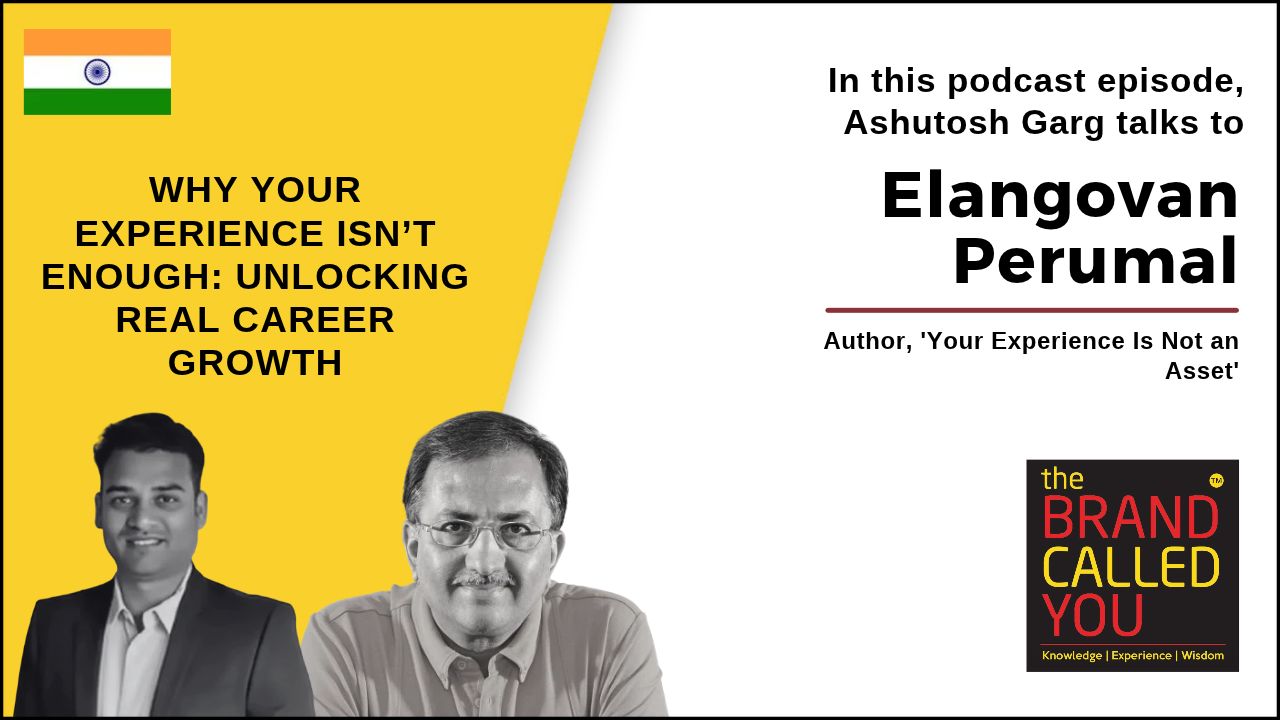
Elangovan Perumal, Author & Strategy Leader, on Career Growth and Transformation
- Elangovan Perumal describes a gradual realization rather than a single defining moment.
- He reflects on how simply accumulating years of experience or working for major brands does not automatically create value.
Podcast
Podcast: Play in new window | Download
Follow TBCY RSS
Overview
In this insightful episode of The Brand Called You, Ashutosh Garg engages Elangovan Perumal, author of Your Experience Is Not an Asset, in a deep-dive conversation about experience, career capital, and the evolving dynamics of professional growth in the age of AI.
00:59 — Was there a moment when experience alone didn’t translate into influence or opportunities?
- Elangovan Perumal describes a gradual realization rather than a single defining moment.
- He reflects on how simply accumulating years of experience or working for major brands does not automatically create value.
- He introduces the idea that experience becomes valuable when it is converted into reusable, tangible assets.
02:44 — What did you have to convert in your experience to shift into strategy and transformation leadership?
- The transition required moving from effort-based to thinking-based value creation.
- This involved developing frameworks, judgment, and assessment capabilities.
- Moving from execution to organization-wide impact requires an intentional recalibration of one’s thinking and approach.
04:21 — What reactions does Your Experience Is Not an Asset provoke?
- The title often prompts questions about what constitutes an asset and can initially create disagreement.
- Elangovan emphasizes that experience must be converted into actionable and shareable knowledge.
- Years of experience do not necessarily equate to years of learning.
05:54 — What does conversion look like for those stuck at a career plateau?
- Identify the problems you have repeatedly solved, extract the patterns, and articulate frameworks from them.
- The real asset comes from documenting and sharing your methods and insights, rather than simply accumulating years of experience.
- Value lies in judgment, decision-making, and diagnostic ability.
08:18 — What is the “Career Capital Operating System,” and how does it work?
- Elangovan describes it as a flywheel rather than a linear sequence.
- The process involves: Experience → Examine & Structure → Articulate → Signal → Gain Influence & Opportunities → Govern Career Decisions.
- Signals and reputation are central to ensuring that career capital remains reusable across different contexts.
10:03 — How is career capital different from credentials, titles, or résumés?
- Credentials: Proof of completion or qualification.
- Titles: Indicate a person’s current position or role.
- Résumés: Record past experiences and activities.
- Career capital: Demonstrated ability to reliably create new value in new contexts.
11:44 — Can a signal quietly harm your reputation without you realizing it?
- Yes. Signals are often confused with visibility.
- Using passive or indirect verbs such as “supported,” “helped,” or “was involved” can weaken the perception of ownership and impact.
- Strong signals come from clearly communicating ownership of outcomes and value creation.
13:51 — How can introverts or low-key professionals build strong signals?
- Start small by documenting your thinking and teaching others, even within your immediate circle.
- Create evidence of your expertise gradually.
- Small actions, such as sharing documented solutions through email, can build positive professional signals over time.
16:03 — How does AI penalize unstructured experience and amplify clear thinkers?
- AI amplifies both clarity and confusion.
- Professionals with structured thinking can extract greater value by providing better prompts and context and critically reviewing AI-generated outputs.
- Those without structured thinking may simply amplify mediocre results, making gaps in their reasoning more visible.
RESOURCES
Learn more about Elangovan Perumal: LinkedIn
ENJOYED THIS PODCAST?
With AI becoming increasingly embedded in the workplace, structured thinking can provide significant leverage. Without clear thinking, AI can amplify gaps in reasoning and judgment. As repetitive activities become increasingly commoditized, judgment, synthesis, and context become more important.
Share your thoughts in the comments and help spread these insights throughout your network.
Would you love to give us 5 stars? ⭐⭐⭐⭐⭐ If yes, we’d greatly appreciate your review. Help us reach more people as we bring conversations with leaders, high achievers, and thought leaders from diverse backgrounds and nationalities. Excellence can come from anywhere. Stay informed and hear from emerging achievers and experts from around the world.
Stay updated with what’s shaping the world today through the latest The Brand Called You Podcast episode. Follow us on iTunes, Spotify, and Anchor.fm.
You can find us at:
Website: www.tbcy.in
Instagram: http://bit.ly/3HO7N06
Facebook:http://bit.ly/3YzJOaD
Twitter: http://bit.ly/3wMBOXK
LinkedIn: https://www.linkedin.com/company/tbcy/
YouTube: http://bit.ly/3jmBqfq
Chingari: https://chingari.io/tbcypodcast
Josh: http://bit.ly/3WWP0nB
Thanks for listening!
Profile
- Elangovan Perumal is the author of Your Experience Is Not an Asset, exploring the changing meaning of professional experience in today’s workplace.
- He offers insights into career capital, professional growth, and staying relevant amid rapid technological and organizational change.
- His work challenges conventional assumptions about experience and emphasizes the importance of skills, adaptability, and continuous learning.

