
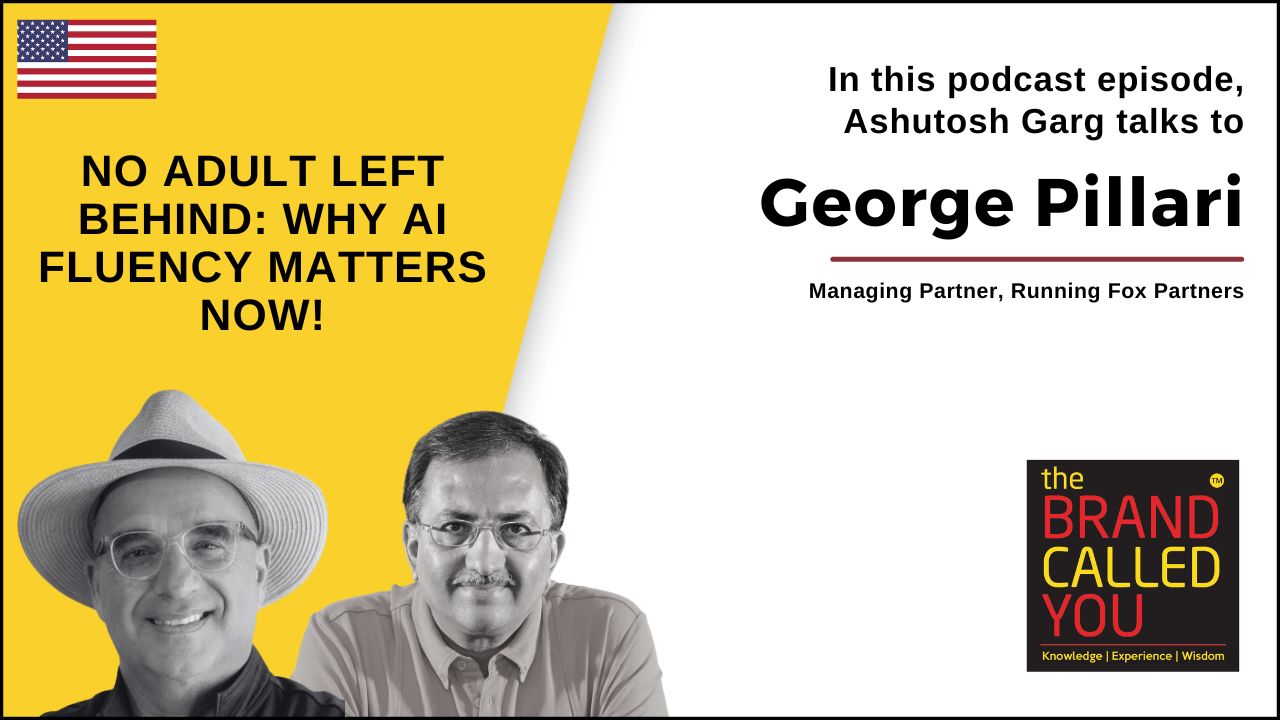
George Pillari, Managing Partner of Running Fox Partners, on Embracing AI for Lifelong Success
- Early experiences as a young entrepreneur
- Advice from experienced colleagues about “growing up” as a leader
Podcast
Podcast: Play in new window | Download
Follow TBCY RSS
Overview
In this episode of The Brand Called You, George Pillari, Managing Partner of Running Fox Partners, joins host Ashutosh Garg to discuss leadership lessons from decades of experience in healthcare, insights from his book No Adult Left Behind: AI Is Learning, Are You?, and practical advice for embracing artificial intelligence in both personal and professional life.
The conversation explores why AI is fundamentally different from previous technology waves, what it means to become “AI fluent,” and why everyone—especially experienced professionals—must adapt to avoid being left behind.
00:46 – What defining moments shaped George Pillari’s leadership philosophy?
- Early experiences as a young entrepreneur
- Advice from experienced colleagues about “growing up” as a leader
- Realization that people often act in their own self-interest—an important insight for understanding leadership
02:24 – What separates successful leaders from those who struggle?
- Patterns observed in distressed healthcare organizations
- The danger of management continuing with flawed plans or visions
- Example of a failed hospital transplant program caused by poor strategic judgment
- How boards can fail to challenge poor management decisions
04:18 – Why the book title “No Adult Left Behind”? Who is at risk of being left behind?
- Inspiration from the U.S. “No Child Left Behind” legislation
- Why adults may resist learning foundational skills because they already perceive themselves as successful
- The disparity in AI adoption among professionals, friends, and peers
- The risk faced by mid- and late-career professionals who ignore AI
06:10 – Why is AI fundamentally different from spreadsheets, email, or the internet?
- AI is becoming pervasive across industries, much like the internet—but with an even broader reach
- AI is increasingly embedded invisibly into everyday systems and processes
- Examples from healthcare and aviation
- AI as foundational “gridwork” for future tools and processes
07:11 – What is the biggest mistake executives make about AI?
- Treating AI as just another free tool
- Underestimating its capabilities and the importance of investing in AI education and resources
- How fear or reluctance to learn new technology can cause professionals to fall behind rapidly
08:46 – What is the simplest first step to start using AI?
- Use AI to evaluate and improve your LinkedIn profile or résumé
- Upload your documents and ask AI for specific suggestions or rewrites
- Use AI as a personal productivity tool to experience its immediate benefits
10:09 – What does “AI fluency” mean in practical terms?
- Going beyond basic search queries
- Providing AI with personal context to receive more relevant and tailored responses
- Understanding how detailed, scenario-based prompts can produce better results than simple searches
11:24 – What’s the difference between search, chatbots, and agents—and why is this critical?
- Search: Helps users find and retrieve information from a vast pool of sources
- Chatbots: Provide responses within a defined knowledge or conversational context
- Agents: Can perform tasks and make decisions with varying levels of autonomy
- Examples include booking travel and summarizing emails or news
- Why users need to be cautious when giving AI agents too much autonomy
15:20 – Will prompting become as fundamental as email or spreadsheets?
- Prompt engineering as an essential future workplace skill
- The value of effective prompting lies not only in technical knowledge but also in clear thinking and context
- Why professionals should upskill and develop this increasingly important ability
16:39 – Is recruitment now a “battle of the bots”?
- How AI-powered résumé screening can filter out strong candidates before human review
- Why applicants should use AI to optimize their résumés
- The continued importance of networking and building genuine professional relationships
- The need to balance technological skills with human connection
RESOURCES
Learn more about George Pillari: LinkedIn
ENJOYED THIS PODCAST?
The Big Truth: AI is not like spreadsheets or email. You could choose whether or not to use those technologies, but AI is increasingly becoming woven into every job, industry, and aspect of everyday life.
Ignore it, and you risk falling behind quickly.
What are your thoughts on AI and the future of work? Share your perspective in the comments and help spread these insights across your network.
Would you love to give us 5 stars? ⭐⭐⭐⭐⭐ If yes, we’d greatly appreciate your review. Help us reach more people as we bring conversations with leaders, high achievers, and thought leaders from diverse backgrounds and nationalities. Excellence can come from anywhere. Stay informed and hear from emerging achievers and experts from around the world.
Stay updated with what’s shaping the world today through the latest The Brand Called You Podcast episode. Follow us on iTunes, Spotify, and Anchor.fm.
You can find us at:
Website: www.tbcy.in
Instagram: http://bit.ly/3HO7N06
Facebook:http://bit.ly/3YzJOaD
Twitter: http://bit.ly/3wMBOXK
LinkedIn: https://www.linkedin.com/company/tbcy/
YouTube: http://bit.ly/3jmBqfq
Chingari: https://chingari.io/tbcypodcast
Josh: http://bit.ly/3WWP0nB
Thanks for listening!
Profile
- George Pillari is the Managing Partner of Running Fox Partners, bringing decades of experience in healthcare and organizational leadership.
- He is the author of No Adult Left Behind: AI Is Learning, Are You?, which explores the urgent need for professionals to understand and adapt to artificial intelligence.
- George advocates becoming AI fluent, encouraging experienced professionals and leaders to embrace continuous learning rather than fear technological change.

