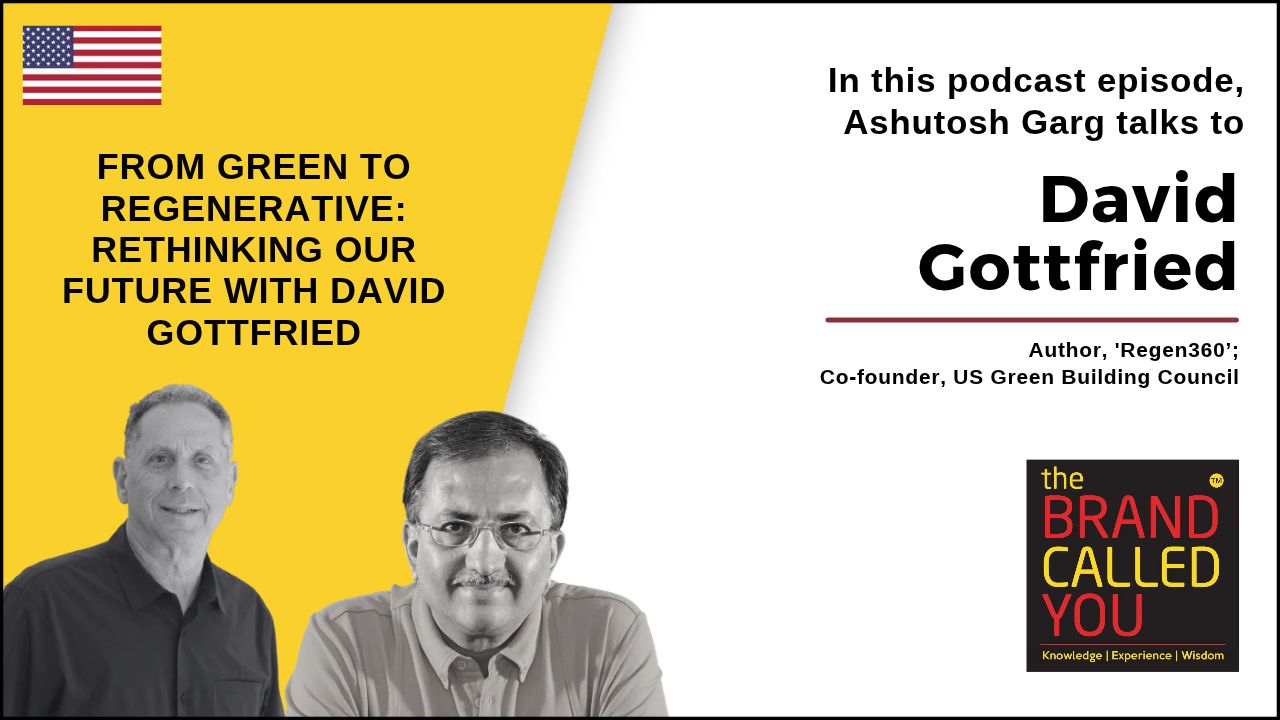
David Gottfried, Author & Co-Founder, U.S. Green Building Council
- David Gottfried discusses his engineering and real estate background.
- Buildings account for 30–40% of global electricity use.
Podcast
Podcast: Play in new window | Download
Follow TBCY RSS
Overview
In this insightful episode of The Brand Called You, Ashutosh Garg sits down with David Gottfried, author of Regen360: An Operating System for a Regenerative Earth and co-founder of the U.S. Green Building Council. Together, they explore the future of our planet, the impact of green buildings, the limitations of conventional measures of growth, and the evolution from sustainability to regeneration.
00:54 – What inspired the idea that buildings could improve the planet’s health?
- David Gottfried discusses his engineering and real estate background.
- Buildings account for 30–40% of global electricity use.
- Construction waste and indoor toxins have significant environmental and health impacts.
- Buildings can serve as a major lever for economic and environmental change.
02:11 – What decisions transformed green building into a global movement?
- Formation of the U.S. Green Building Council through horizontal, multidisciplinary collaboration.
- Creation of the LEED rating system.
- Global expansion with adaptations to local cultures and contexts.
- Green Building Councils now operate in more than 85 countries.
04:24 – Why is sustainability no longer enough? When did “regeneration” become necessary?
- David Gottfried describes his growing focus on climate data and the accelerating pace of environmental change.
- The Paris Agreement and the urgency surrounding the 1.5°C threshold highlighted the need for stronger action.
- Despite progress, major systemic challenges remain unresolved.
- Regeneration requires addressing broader ecological and social systems, not just buildings.
06:42 – What is “Civilization 1.0,” and how has it failed us?
- A consumption-driven, post-World War II growth paradigm developed without fully accounting for its environmental and social costs.
- Ecological destruction, pollution, and resource depletion have often been treated as externalities.
- Conventional measures such as GDP and corporate profits do not fully reflect human and planetary well-being.
08:19 – What should we measure instead of economic growth and corporate profits?
- David Gottfried proposes Gross Ecosystem Product and HOPE (Health on Planet Earth) as broader measures of progress.
- Capitalism should create stronger incentives for activities that improve planetary health.
- True wealth can be viewed through the lens of improved health for both people and the planet.
09:53 – How do we turn hope from a philosophy into a measurable discipline?
- David Gottfried distinguishes emotional hope from actionable hope.
- He introduces a “bullseye” model, placing life at the center and surrounding it with life-sustaining factors.
- He presents the equation R = P − I − W: Result = Product − Inputs − Waste.
12:13 – What are the 15 Earth Codes of the regenerative operating system, and how were they created?
- The book was developed through recorded dialogues and AI-assisted synthesis.
- More than 2,600 pages of material were condensed into 15 elemental Earth Codes.
- Each code has its own chapter and equation, forming the foundation of the Regen OS.
14:27 – What would a truly regenerative company look like?
- Companies are beginning to move toward regeneration, although few have fully achieved it.
- Net zero should be considered a minimum rather than the ultimate goal; the aim should be to become net positive.
- Companies need transparent data collection, measurable targets, and products and services designed to benefit the planet.
17:18 – What is “soul worth,” and why does it matter?
- David Gottfried distinguishes between net worth, self-worth, and soul worth.
- Soul worth emphasizes service, gratitude, purpose, and creating a positive impact.
- He reflects on his personal transition from a focus on financial success toward global contribution and education.
RESOURCES
Learn more about David Gottfried: LinkedIn
ENJOYED THIS PODCAST?
Why focus on buildings? They consume 30–40% of the world’s electricity, contribute significantly to landfill waste, and affect the health and well-being of billions of people. Transforming the built environment can therefore become a massive lever for positive change.
Share your thoughts in the comments and help spread these insights throughout your network.
Would you love to give us 5 stars? ⭐⭐⭐⭐⭐ If yes, we’d greatly appreciate your review. Help us reach more people as we bring conversations with leaders, high achievers, and thought leaders from diverse backgrounds and nationalities. Excellence can come from anywhere. Stay informed and hear from emerging achievers and experts from around the world.
Stay updated with what’s shaping the world today through the latest The Brand Called You Podcast episode. Follow us on iTunes, Spotify, and Anchor.fm.
You can find us at:
Website: www.tbcy.in
Instagram: http://bit.ly/3HO7N06
Facebook:http://bit.ly/3YzJOaD
Twitter: http://bit.ly/3wMBOXK
LinkedIn: https://www.linkedin.com/company/tbcy/
YouTube: http://bit.ly/3jmBqfq
Chingari: https://chingari.io/tbcypodcast
Josh: http://bit.ly/3WWP0nB
Thanks for listening!
Profile
- David Gottfried is the author of Regen360: An Operating System for a Regenerative Earth and co-founder of the U.S. Green Building Council.
- He is a pioneer in green building, sustainable development, and regenerative design, promoting innovative approaches to environmental challenges.
- His work challenges conventional measures of economic growth and sustainability, advocating for a broader regenerative approach.

