
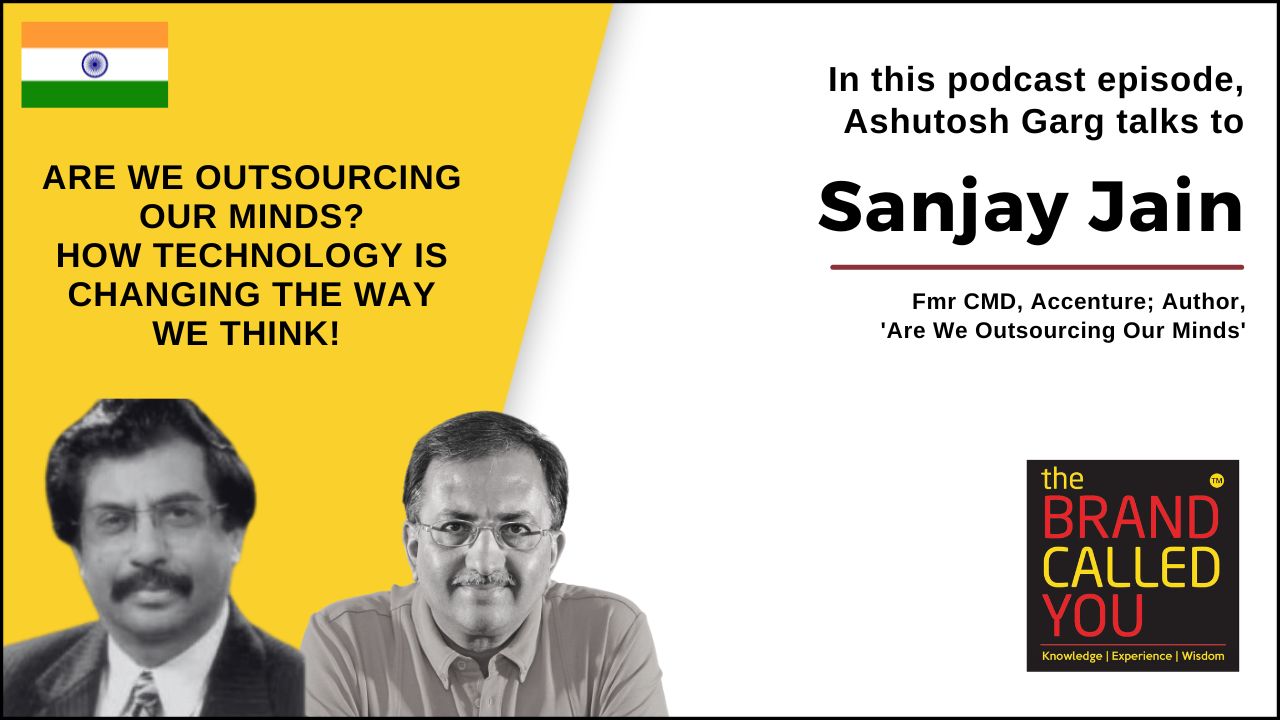
Sanjay Jain, Former CMD, Accenture & Author, on AI, Technology & Cognitive Skills
- Transitioning from consulting in the United States to establishing Accenture’s New Delhi office.
- The invaluable role of mentors in shaping a successful career.
Podcast
Podcast: Play in new window | Download
Follow TBCY RSS
Overview
Technology has transformed the way we live, work, and learn—but what impact is it having on the way we think?
In this thought-provoking conversation, Sanjay Jain, Former CMD of Accenture and author of Are We Outsourcing Our Minds?, shares insights from more than four decades of leadership in strategy, consulting, technology, and outsourcing. Together with Ashutosh Garg, he explores how tools such as calculators, smartphones, and Generative AI are reshaping our cognitive abilities, learning processes, and decision-making.
Drawing on neuroscience, research, and personal experiences, Sanjay explains how technology can either enhance or diminish our cognitive capabilities, depending on how we choose to use it. The discussion also offers practical strategies for individuals, parents, educators, and leaders to preserve curiosity, critical thinking, and lifelong learning in an increasingly digital world.
01:00-Defining Moments: What Shaped a Four-Decade Corporate Journey?
- Transitioning from consulting in the United States to establishing Accenture’s New Delhi office.
- The invaluable role of mentors in shaping a successful career.
- Lessons on timing, leading before having authority, and building lasting institutions.
- Why continual reinvention is essential for long-term success.
05:23-Outsourcing Our Minds: What Does It Really Mean?
- Technology reduces cognitive load through tools such as spell-check, GPS, and automation, giving us more time and attention.
- The neurological cost of relying on technology as a substitute rather than a partner is the gradual weakening of critical cognitive functions.
- How excessive dependence on digital tools can create learned helplessness and reduce self-confidence.
- Understanding the Flynn Effect and how the widespread adoption of smartphones has coincided with declining cognitive performance among younger generations.
08:34-Calculators & Cognitive Skills: Do Digital Tools Weaken Mental Math?
- Overreliance on calculators may reduce activity in the dorsolateral prefrontal cortex (DLPFC), which supports reasoning and working memory.
- Why performing mental calculations strengthens cognitive function.
- Personal experiences of identifying spreadsheet errors through strong mental arithmetic.
- The importance of building mathematical thinking in childhood and maintaining mental exercise throughout life.
12:07-The Power of Handwriting: How Does It Benefit the Brain Compared with Typing?
- Handwriting slows the thinking process, encouraging deeper understanding and better retention.
- Neuroscientific research shows that handwriting activates memory and learning centers more effectively than typing.
- Studies comparing handwritten and typed notes consistently demonstrate stronger recall from handwritten notes.
- Learning a new language or writing system, such as Urdu, can stimulate different parts of the brain and may help support long-term cognitive health.
16:39-The Smartphone Effect: Can Simply Having a Phone Nearby Reduce Your Brainpower?
- Research shows that the mere presence of a smartphone—even when it is silent and placed face down—can reduce working memory and fluid intelligence.
- Resisting the urge to check your phone consumes mental resources, even when the device is not being used.
- Creating intentional distance from digital distractions can improve focus, attention, and productivity.
RESOURCES:
Learn more about Sanjay Jain: LinkedIn
Enjoyed this podcast?
One of the most compelling ideas discussed in this episode is the Reverse Flynn Effect. Since smartphones became widespread, the long-standing rise in IQ scores has slowed—and in some studies, reversed—particularly among young adults. Is it correlation or coincidence? The debate continues, but the timing raises important questions.
Share your thoughts in the comments and help spread these insights across your network.
Would you love to give us 5 stars? ⭐⭐⭐⭐⭐ If yes, we’d greatly appreciate your review. Help us reach more people as we bring conversations with leaders, high achievers, and thought leaders from diverse backgrounds and nationalities. Excellence can come from anywhere. Stay informed and hear from emerging achievers and experts from around the world.
Stay updated with what’s shaping the world today through the latest The Brand Called You Podcast episode. Follow us on iTunes, Spotify, and Anchor.fm.
You can find us at:
Website: www.tbcy.in
Instagram: http://bit.ly/3HO7N06
Facebook:http://bit.ly/3YzJOaD
Twitter: http://bit.ly/3wMBOXK
LinkedIn: https://www.linkedin.com/company/tbcy/
YouTube: http://bit.ly/3jmBqfq
Chingari: https://chingari.io/tbcypodcast
Josh: http://bit.ly/3WWP0nB
Thanks for listening!
Profile
- Sanjay Jain is the former Chairman and Managing Director of Accenture and the author of Are We Outsourcing Our Minds?.
- With over four decades of experience in strategy, consulting, technology, and outsourcing, he has guided organizations through major waves of digital transformation.
- Sanjay explores how technologies such as Generative AI, smartphones, and automation influence critical thinking, learning, decision-making, and human cognition.

