Neil Solomon, Author & Entrepreneur, on Breaking Hidden Systems for a Fulfilling Life
- Following conventional measures of career success early in his career
- Realizing the limitations of the corporate “ceiling” and the personal sacrifices it required
Podcast
Podcast: Play in new window | Download
Follow TBCY RSS
Overview
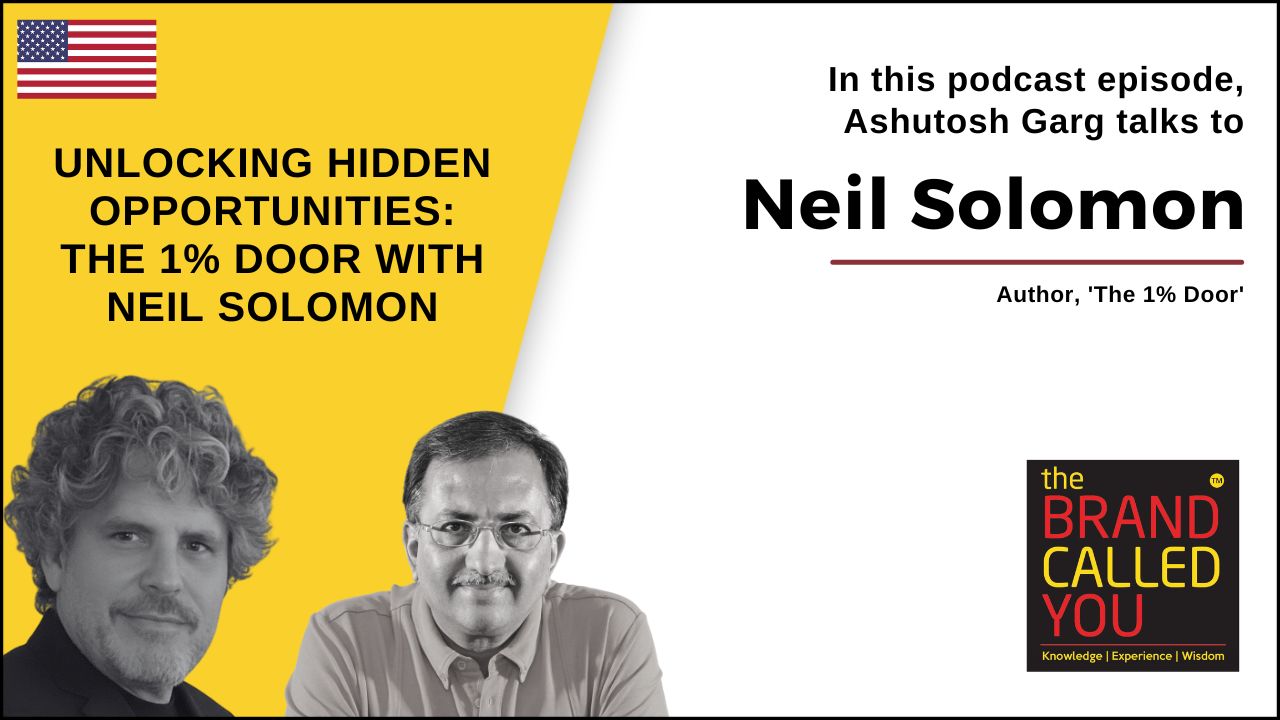
Neil Solomon, author, entrepreneur, and global investor, joins The Brand Called You to discuss his new book, The 1% Door: The Hidden Systems Costing You the Life You Could Be Living. With a career spanning engineering, franchising, and international real estate, Neil shares transformative lessons, setbacks, and the mindset shifts essential for building a fulfilling life and sustainable businesses.
01:07 – What pivotal moments shaped your journey from engineer to entrepreneur?
- Following conventional measures of career success early in his career
- Realizing the limitations of the corporate “ceiling” and the personal sacrifices it required
- Choosing family over career progression
- Discovering that excelling in corporate roles did not always lead to greater rewards, particularly with capped bonuses and continually increasing targets
- Transitioning into entrepreneurship, beginning with work in the food industry
- Embracing reinvention and allowing the “old self” to make way for growth
04:51 – What principles have remained constant across different industries?
- The importance of curiosity and continuous learning
- Recognizing that corporate structures, such as finance and human resources, often remain consistent across industries
- The value of acquiring profitable companies and building strong teams
- Allowing operational experts to manage day-to-day activities
06:07 – What has been your most expensive lesson as a business owner?
- Understanding the emotional and financial costs of mixing business with family
- Accepting that loved ones may have different visions, ambitions, and expectations
07:16 – What habit has created disproportionate results for you?
- The discipline of “getting out of the way” as a leader
- Trusting established systems rather than undermining them as the top executive
- Using the “shower test” by stepping away for hours or weeks to see whether systems can operate independently
- Using travel as a way to test and strengthen operational independence
09:35 – What separates lasting entrepreneurs from those who struggle?
- Persistence in the face of constant challenges, recognizing that there is rarely a completely smooth path
- Navigating changing circumstances, much like sailing toward a destination while dealing with unpredictable winds
- Understanding that evolution and adaptation are necessary, even in the largest and most established businesses
12:43 – What is “The 1% Door,” and why do so few people walk through it?
- It is a metaphor for the opportunities that surround us but often go unnoticed
- Once you train your mind to recognize opportunities, you begin seeing them everywhere
- Only a small percentage of people take action and “walk through the door”
- The book encourages readers to recognize opportunities and have the courage to act on them
15:02 – Why tell your story through stories instead of a traditional business format?
- Exploring legacy and the power of storytelling
- Connecting personal experiences with operating principles and business philosophies
- Creating stories that can be shared with future generations as a form of intergenerational “dinner conversation”
16:58 – What does it mean that many people live inside systems they never chose? Can you give an example?
- Examining the social and cultural “architectures” we inherit rather than consciously choose
- Using the Hamer tribe’s bull-jumping rite in Ethiopia as a powerful example
- Reflecting on how traditions and systems may begin with a purpose but become outdated or even absurd while continuing to persist
20:34 – What part of ourselves must “die” to achieve growth?
- Recognizing that previous identities and skill sets can limit future possibilities
- Being willing to let go of the “old you” to make room for new roles and opportunities
- Understanding that people closest to us may resist or fail to recognize our transformation
22:55 – After reading your book, what question should readers ask themselves?
- “Where do I really want to be, and who do I need to become to get there?”
- Understanding that change is difficult, but a strong “why” can make it possible
- Recognizing that there is no straight line to success and that progress begins with taking one step in the right direction
Enjoyed this podcast?
What is the most expensive lesson an entrepreneur can learn? For Neil Solomon, it was mixing business and family.
“I found it better that the people who I love don’t join me on this part of the journey.”
The cost isn’t just financial—it can be deeply emotional as well.
Share your thoughts in the comments and help spread these insights throughout your network.
Would you love to give us 5 stars? ⭐⭐⭐⭐⭐ If yes, we’d greatly appreciate your review. Help us reach more people as we bring conversations with leaders, high achievers, and thought leaders from diverse backgrounds and nationalities. Excellence can come from anywhere. Stay informed and hear from emerging achievers and experts from around the world.
Stay updated with what’s shaping the world today through the latest The Brand Called You Podcast episode. Follow us on iTunes, Spotify, and Anchor.fm.
You can find us at:
Website: www.tbcy.in
Instagram: http://bit.ly/3HO7N06
Facebook:http://bit.ly/3YzJOaD
Twitter: http://bit.ly/3wMBOXK
LinkedIn: https://www.linkedin.com/company/tbcy/
YouTube: http://bit.ly/3jmBqfq
Chingari: https://chingari.io/tbcypodcast
Josh: http://bit.ly/3WWP0nB
Thanks for listening!
Profile
- Global Entrepreneur & Investor: Brings decades of experience across engineering, franchising, and international real estate.
- The 1% Door: Explores the hidden systems and small barriers that can prevent people from living their fullest potential.
- Lessons from Setbacks: Shares personal experiences and failures that shaped his approach to business and life.

