
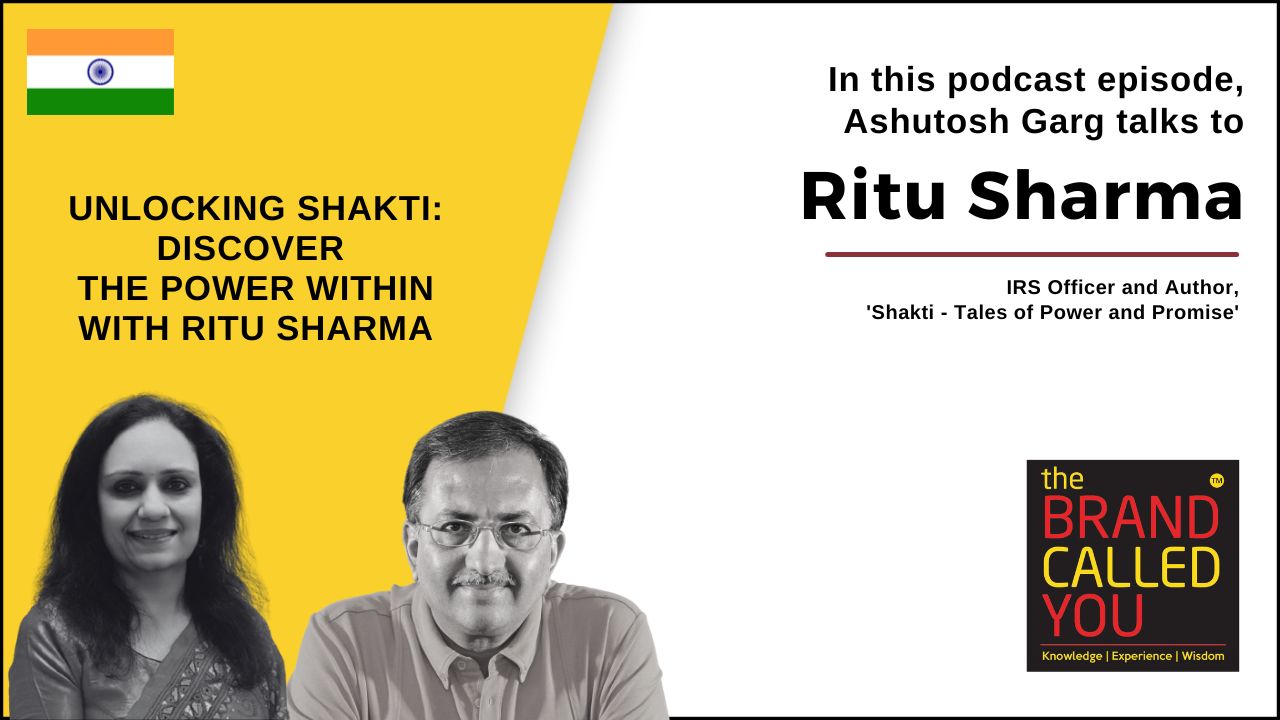
Ritu Sharma, IRS Officer & Author of Shakti – Tales of Power and Promise, on the Power of the Divine Feminine
- Ritu Sharma shares vivid memories of growing up in a village in Haryana and experiencing rituals at her ancestral temple.
- She reflects on the contrast between the reverence shown toward goddesses and the roles of women in everyday life.
Podcast
Podcast: Play in new window | Download
Follow TBCY RSS
Overview
In this episode of The Brand Called You, IRS officer and author Ritu Sharma delves into the essence of her book, Shakti: Tales of Power and Promise, and her personal journey with the Divine Feminine. The conversation explores her early memories of spirituality, the origins and meaning of Shakti, the paradox of gender roles in society, and the empowering messages that ancient narratives hold for women today.
00:48 — How did growing up around an ancestral Shiva temple shape your spirituality?
- Ritu Sharma shares vivid memories of growing up in a village in Haryana and experiencing rituals at her ancestral temple.
- She reflects on the contrast between the reverence shown toward goddesses and the roles of women in everyday life.
- These experiences sparked her curiosity and deepened her interest in Shakti.
03:37 — What about Shakti captivated you as a young girl?
- Ritu Sharma recalls questioning why the names of Shakti and Shiva were always spoken together.
- She reflects on the contrast between the worship of the goddess and the everyday experiences of women.
- These observations led her to explore ideas of equality, power, and divinity.
05:11 — Why did you write Shakti: Tales of Power and Promise as a journey rather than a theological argument?
- Ritu Sharma describes the book as a travelogue rather than a systematic study or theological commentary.
- She focuses on relatable questions and firsthand experiences at various Shaktipeeths.
- The book explores personal doubts, cultural rituals, miracles, and the meaning of Shakti beyond academic debate.
08:19 — How do you explain the concept of Shakti to someone unfamiliar with Hindu philosophy?
- Ritu Sharma introduces the traditions of Shaivism, Vaishnavism, and Shaktism.
- She explains Shakti as the essential dynamic energy underlying the cosmos, rather than simply a deity.
- She also draws connections between the idea of universal energy and concepts explored in modern science.
10:22 — Is Shakti a deity, an energy, a philosophy, or all three?
- Ritu Sharma explores Shakti’s evolution from a nature goddess to a central figure in spiritual traditions.
- She highlights Shakti’s presence in everyday life, including food, adornment, nature, and human experiences.
- Shakti is presented as both an energy and a philosophy that exists within everyone.
12:34 — What deeper lessons does the story of Sati hold for modern readers?
- The conversation explores both the apparent and hidden meanings within the story of Sati.
- Ritu Sharma reflects on sacrifice, societal expectations, and the transformation required to sustain cosmic order.
- The legend is viewed as a symbol of the goddess’s role in restoring balance and order.
15:55 — What message do you hope young girls will take from your book?
- Ritu Sharma emphasizes the importance of looking within and gathering one’s inner strength when facing challenges.
- She highlights self-empowerment, adaptability, and transformation.
- She encourages readers to walk alongside the goddess and discover the relevance of Shakti in contemporary life.
17:53 — How can modern women draw strength from ancient narratives without feeling constrained by tradition?
- Ritu Sharma distinguishes between the surface meanings and deeper messages within myths.
- She encourages women to seek inspiration and inner empowerment rather than follow traditional narratives literally.
- The goddess becomes a model for inner strength beyond ritual and superstition.
19:22 — How do you reconcile the widespread worship of the goddess with ongoing gender inequality?
- Ritu Sharma points out that reverence for the goddess does not necessarily translate into respect for women in society.
- She calls for an internal shift toward recognizing and embodying Shakti’s inner strength in everyday life.
RESOURCES
Learn more about Ritu Sharma: LinkedIn
ENJOYED THIS PODCAST?
The story of Sati is more than mythology. On the surface, it speaks of sacrifice, conflict, and the relationship between a husband and his father-in-law. But Ritu Sharma explores a deeper lesson: profound sacrifice and transformation can play a role in restoring balance and bringing divine order.
What are your thoughts on the deeper meaning of Shakti and the story of Sati? Share your perspective in the comments and help spread these insights across your network.
Would you love to give us 5 stars? ⭐⭐⭐⭐⭐ If yes, we’d greatly appreciate your review. Help us reach more people as we bring conversations with leaders, high achievers, and thought leaders from diverse backgrounds and nationalities. Excellence can come from anywhere. Stay informed and hear from emerging achievers and experts from around the world.
Stay updated with what’s shaping the world today through the latest The Brand Called You Podcast episode. Follow us on iTunes, Spotify, and Anchor.fm.
You can find us at:
Website: www.tbcy.in
Instagram: http://bit.ly/3HO7N06
Facebook:http://bit.ly/3YzJOaD
Twitter: http://bit.ly/3wMBOXK
LinkedIn: https://www.linkedin.com/company/tbcy/
YouTube: http://bit.ly/3jmBqfq
Chingari: https://chingari.io/tbcypodcast
Josh: http://bit.ly/3WWP0nB
Thanks for listening!
Profile
- Ritu Sharma is an IRS officer and author of Shakti: Tales of Power and Promise, exploring the enduring significance of the Divine Feminine.
- Her personal journey reflects a deep connection with spirituality, shaped by early memories and experiences with Indian traditions.
- Through Shakti, she examines power, gender roles, and societal expectations, offering fresh perspectives on women’s empowerment.

