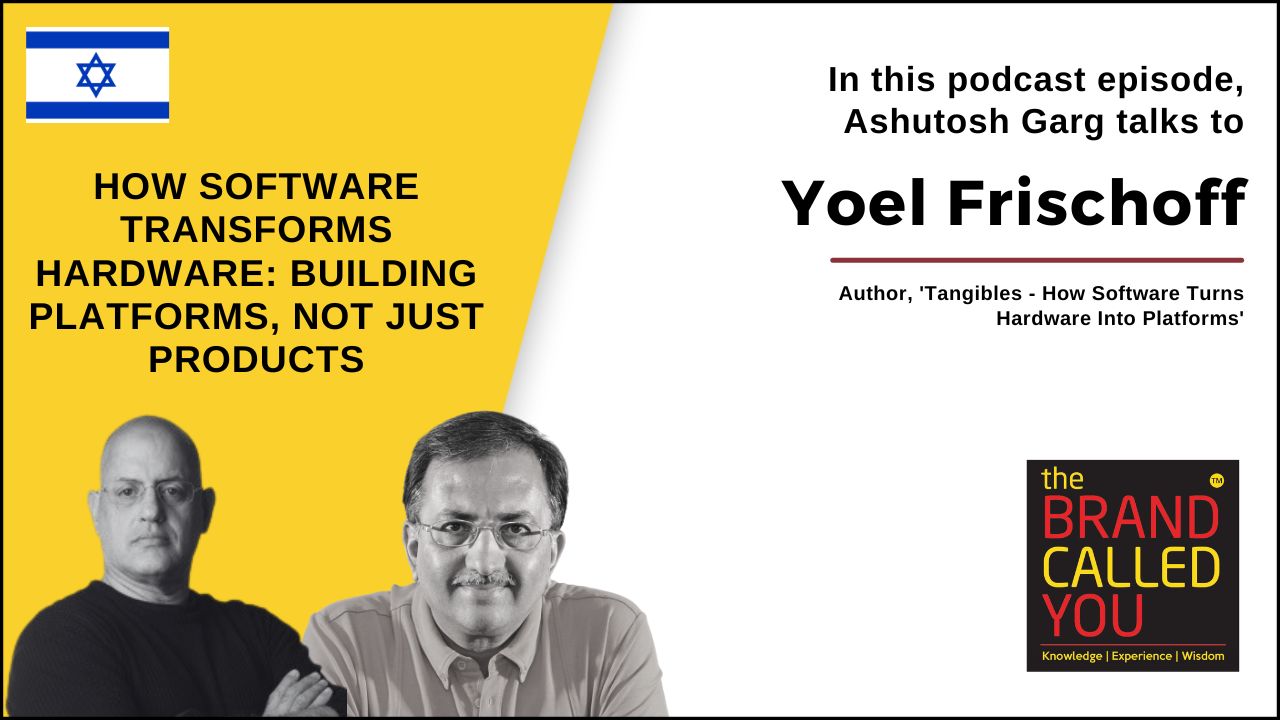
How Software Transforms Hardware into Platforms | Yoel Frischoff, Author of Tangibles
- Hardware innovation involves significant upfront investment and inherent business risks.
- Globalization has made manufacturing more accessible while intensifying supplier competition.
Podcast
Podcast: Play in new window | Download
Follow TBCY RSS
Overview
In this conversation, Yoel explores how software is transforming traditional physical products into evolving platforms and reshaping business strategies in the connected-device industry. Drawing on his extensive experience in product design and strategy, he discusses the challenges of developing hardware products, the importance of software integration, and the opportunities created by connected technologies.
Here is a recap of the key topics discussed, along with important insights and timestamps to help you explore the conversation.
00:50 – What sparked the realization that physical design alone isn’t enough for product success?
- Hardware innovation involves significant upfront investment and inherent business risks.
- Globalization has made manufacturing more accessible while intensifying supplier competition.
- Suppliers can become competitors, putting pressure on pricing and accelerating innovation cycles.
02:07 – Which product launch changed your perspective on product strategy?
- The transition from children’s entertainment to educational hardware without changing the physical product.
- Using different software solutions to serve new customer segments and markets.
- Moving beyond traditional sales towards subscription models and institutional customers, including government organizations.
03:32 – Why does the hardware-software industry need a new playbook?
- Traditional hardware and software development follow very different frameworks.
- Companies lack an integrated approach to connectivity, business models, and post-sale value creation.
- A unified strategy is essential to manage the entire product lifecycle in the digital era.
05:01 – What defines a “tangible” versus a “smart” product?
- A tangible is a physical product enhanced by software that continues to evolve after shipping.
- “Smart” is often a marketing term, whereas “tangible” emphasizes continuous software-driven value.
- A useful test is to remove the software and assess how much of the product’s original value remains.
06:34 – Why is hardware development more challenging than software development?
- Hardware ventures face significantly greater long-term survival challenges than software businesses.
- Physical design mistakes are expensive to correct, unlike software issues that can often be resolved through updates.
- Significant capital is committed long before revenue begins, creating financial pressure.
08:01 – How can companies identify whether their products risk being replaced by smartphone features?
- Companies should assess whether their product’s core functionality can be replicated by devices customers already own.
- Smartphones have absorbed several standalone product categories, including cameras, flashlights, and GPS devices.
- Products with unique physical capabilities, specialized applications, or regulatory requirements may be better protected from obsolescence.
09:24 – What does a defensible competitive moat look like for hardware companies today?
- Competitive advantages increasingly come from customer habits, ecosystems, and switching costs rather than patents alone.
- Tesla demonstrates how continuous software updates can strengthen the customer experience.
- iRobot illustrates the challenges of sustaining a competitive business model despite technological innovation.
11:14 – Why does the standby paradox matter for connected products?
- Connected devices must balance readiness and responsiveness with periods of inactivity.
- Maintaining availability while managing power consumption and system resources is an important product-design challenge.
- Standby behavior needs to be considered as part of the overall connected-product experience.
13:00 – What changes when a company transitions to connected products?
- Connectivity enables continuous improvements, firmware updates, and data collection.
- Connected products introduce additional cybersecurity vulnerabilities.
- Companies must plan for ongoing security, resilience, and risk management throughout the product lifecycle.
14:46 – Where do companies commonly break the “Sense-Decide-Act” feedback loop?
- Many companies focus on collecting data without converting it into meaningful decisions.
- Poorly designed alerts can create alarm fatigue and overwhelm operational teams.
- Overreliance on human intervention at the action stage can increase costs and reduce efficiency.
16:07 – How does a decoupled MVP process work for hardware?
- Hardware and software development operate at different speeds and should be validated independently.
- Each layer, including prototyping, design, software, and commercial viability, requires its own proof of concept.
- Independent validation helps reduce risks and prevents costly failures later in development.
19:09 – What can heritage brands like Swatch learn from the smartwatch disruption?
- Established brands should leverage their existing strengths while adapting to changing technologies.
- The smartwatch revolution demonstrated how quickly traditional product categories can be disrupted.
- Heritage brands must rethink their products and explore new ways to remain relevant in evolving markets.
RESOURCES
Learn more about Yoel Frischoff and his professional work through his LinkedIn profile.
ENJOYED THIS PODCAST?
The discussion explored how single-purpose gadgets can be absorbed by multifunctional platforms. Smartphones, for example, have replaced the need for several standalone devices, including cameras, flashlights, and GPS units.
The important question is: Can your product’s core functionality be replicated by a device customers already carry?
Share your thoughts and perspectives in the comments!
Would you love to give us 5 stars? ⭐⭐⭐⭐⭐ If yes, we’d greatly appreciate your review. Help us reach more people as we bring conversations with leaders, high achievers, and thought leaders from diverse backgrounds and nationalities. Excellence can come from anywhere. Stay informed and hear from emerging achievers and experts from around the world.
Stay updated with what’s shaping the world today through the latest The Brand Called You Podcast episode. Follow us on iTunes, Spotify, and Anchor.fm.
You can find us at:
Website: www.tbcy.in
Instagram: http://bit.ly/3HO7N06
Facebook:http://bit.ly/3YzJOaD
Twitter: http://bit.ly/3wMBOXK
LinkedIn: https://www.linkedin.com/company/tbcy/
YouTube: http://bit.ly/3jmBqfq
Chingari: https://chingari.io/tbcypodcast
Josh: http://bit.ly/3WWP0nB
Thanks for listening!
Profile
-
Yoel brings extensive experience in product design and strategy, particularly in the connected-device industry.
-
Explores how software integration is transforming traditional hardware products into evolving platforms.
-
Focuses on the challenges of hardware development and the opportunities created by connected technologies.

