
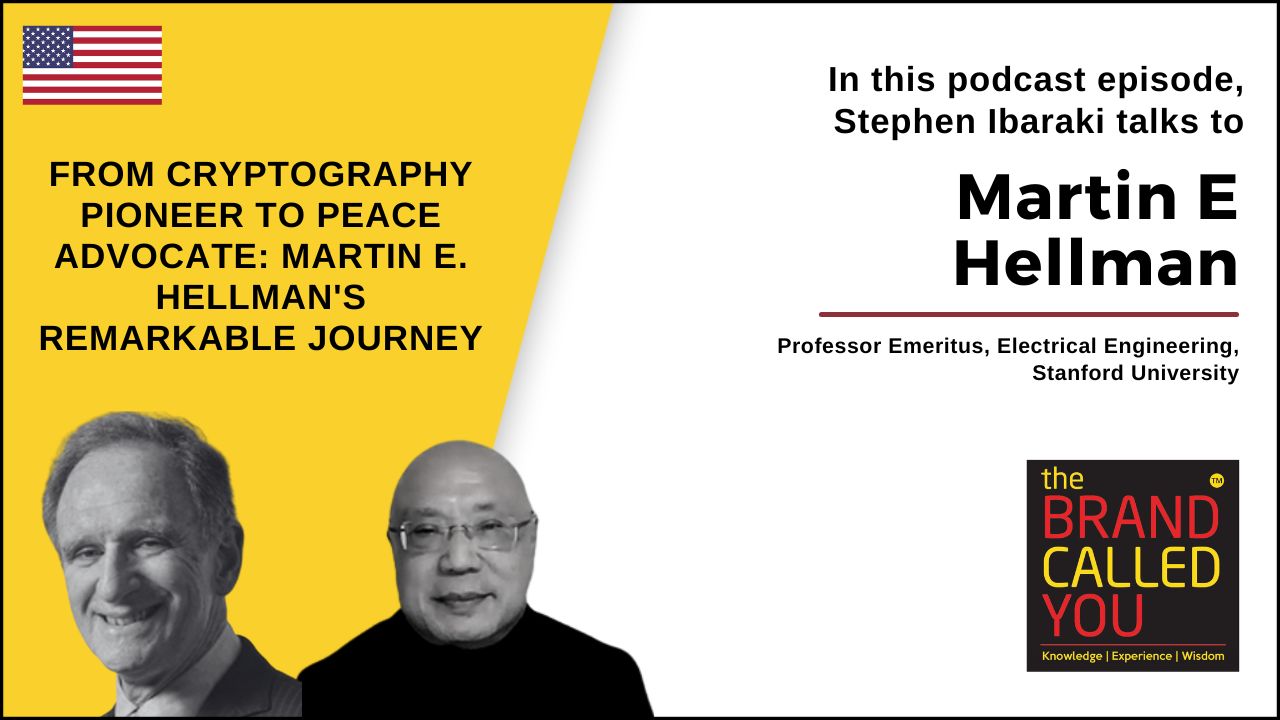
Martin E. Hellman, Professor Emeritus of Electrical Engineering at Stanford University
- Early experiences with prejudice and their lasting impact on his identity.
- Meeting his future wife and lifelong partner, Dorothy.
Podcast
Podcast: Play in new window | Download
Follow TBCY RSS
Overview
Join us for a thought-provoking conversation with Martin E. Hellman, Professor Emeritus of Electrical Engineering at Stanford University and a renowned pioneer of secure digital communications. In this episode, Martin reflects on the personal, academic, and professional turning points that shaped his remarkable career, sharing valuable insights into scientific innovation, ethics, leadership, and global peace.
01:06 – What were the defining moments that shaped Martin Hellman’s life and career?
- Early experiences with prejudice and their lasting impact on his identity.
- Meeting his future wife and lifelong partner, Dorothy.
- Discovering Claude Shannon’s work on information theory and cryptography while at MIT.
- The importance of grit, resilience, and personal agency in overcoming challenges.
06:05 – How did family, education, and curiosity nurture Hellman’s scientific journey?
- Growing up in a curiosity-driven household with educator parents.
- Experiencing freedom, experimentation, and learning through childhood discoveries.
- Studying at Bronx High School of Science, NYU, and Stanford.
- Moving from an initial dislike of mathematics to embracing abstract mathematical concepts during graduate studies.
13:17 – How did Hellman’s early professional and industrial experiences shape his career?
- Gaining practical experience at Wheeler Laboratories, Aerospace Corporation, TRW, and IBM Watson.
- Exploring classified research, Cold War-era nuclear strategy, and the role of computers in scientific research.
- Learning from experienced mentors, senior scientists, and physicists.
23:07 – How was public-key cryptography pioneered, and what impact did it have?
- Collaborating with Whitfield Diffie and exchanging ideas with Ralph Merkle.
- Publishing New Directions in Cryptography, which established a foundation for secure communication between strangers over open channels.
- Understanding the importance of digital signatures in modern security, including secure software updates and digital authentication.
24:17 – What controversies and milestones shaped the development of cryptography?
- Examining the debates surrounding the Data Encryption Standard (DES) and concerns about its security.
- Exploring the evolving relationship between academia, industry, and government agencies such as the NSA and NIST.
29:25 – How did Hellman’s peace activism and commitment to inclusion expand his influence?
- Becoming involved in peace initiatives through organizations such as Beyond War and engaging in dialogue with Soviet scientists during the Cold War.
- Promoting diversity and introducing a “no-fault approach to prejudice” at Stanford.
- Exploring the value of cross-cultural understanding and interdisciplinary collaboration.
37:09 – What leadership roles defined Hellman’s tenure at Stanford?
- Serving as director of Stanford’s Information Systems Laboratory.
- Supporting faculty development and academic advancement, including the tenure process for Dwight Nishimura.
42:15 – How does Hellman view technological and policy risks in today’s world?
- Contributing to national policy discussions and committees on cryptography.
- Advocating for a critical reassessment of conventional national security assumptions.
- Promoting bipartisan approaches to existential threats, particularly the risks associated with nuclear weapons.
- Comparing humanity’s technological power to adolescent maturity and emphasizing the need to “grow up” and accept greater responsibility.
RESOURCES
Learn more about Martin E. Hellman and his professional work through his LinkedIn profile.
ENJOYED THIS PODCAST?
One particularly fascinating aspect of this conversation was Martin’s freedom-filled, curiosity-driven childhood. At just six years old, he and other children could take the subway across New York to visit the Museum of Natural History!
That freedom to explore, experiment, and even make mistakes helped develop his resilience, independence, and innovative thinking. His experiences remind us that curiosity and the freedom to learn through experimentation can shape a lifetime of discovery.
Share your thoughts and perspectives in the comments!
Would you love to give us 5 stars? ⭐⭐⭐⭐⭐ If yes, we’d greatly appreciate your review. Help us reach more people as we bring conversations with leaders, high achievers, and thought leaders from diverse backgrounds and nationalities. Excellence can come from anywhere. Stay informed and hear from emerging achievers and experts from around the world.
Stay updated with what’s shaping the world today through the latest The Brand Called You Podcast episode. Follow us on iTunes, Spotify, and Anchor.fm.
You can find us at:
Website: www.tbcy.in
Instagram: http://bit.ly/3HO7N06
Facebook:http://bit.ly/3YzJOaD
Twitter: http://bit.ly/3wMBOXK
LinkedIn: https://www.linkedin.com/company/tbcy/
YouTube: http://bit.ly/3jmBqfq
Chingari: https://chingari.io/tbcypodcast
Josh: http://bit.ly/3WWP0nB
Thanks for listening!
Profile
-
Martin E. Hellman is Professor Emeritus of Electrical Engineering at Stanford University and a pioneer of secure digital communications.
-
Best known for his groundbreaking contributions to public-key cryptography, transforming the field of digital security.
-
Has dedicated his career to advancing scientific innovation, ethical responsibility, and intellectual exploration.

