Kent Thoresen, Author of Donecraft, on Turning Ideas into Results
- Project success often depends more on the approach taken than on the country or industry.
- Projects that begin successfully can lose momentum when leadership or ownership changes.
Podcast
Podcast: Play in new window | Download
Follow TBCY RSS
Overview
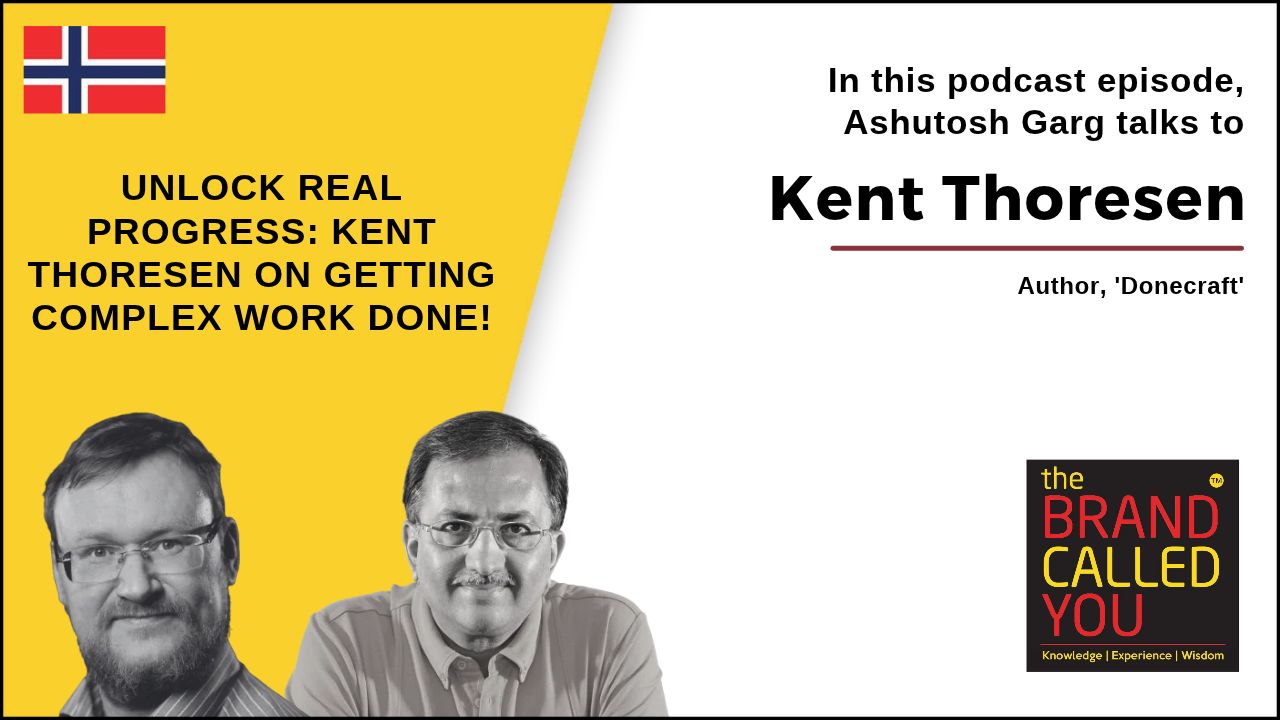
Welcome to an insightful episode of The Brand Called You, in which host Ashutosh Garg speaks with Norwegian author Kent Thoresen about his book Donecraft. Drawing on 27 years of experience across global startups and industrial projects, Kent explains why promising ventures fail and how better planning, clearer outcomes, and more effective decision-making can help turn ambitious ideas into reality.
In this conversation, Kent shares practical strategies for structuring complex work, identifying hidden dependencies, and distinguishing meaningful progress from mere activity.
Explore the key questions and insights from the episode below.
01:09 | What Patterns Emerge from Projects Around the World?
- Project success often depends more on the approach taken than on the country or industry.
- Projects that begin successfully can lose momentum when leadership or ownership changes.
- How problems are approached can significantly influence the outcome.
02:10 | Are You a Starter, a Finisher, or Something Else?
- Kent Thoresen describes himself as a “questioner” rather than simply a starter or finisher.
- He distinguishes between managers who ask questions to assign blame and those who ask questions to uncover and solve problems.
- A blame-oriented culture can undermine collaboration and effective problem-solving.
03:30 | What Inspired Kent to Write Donecraft?
- A challenging industrial project revealed how teams can lose sight of long-term outcomes while becoming consumed by short-term activity.
- Large organizations can become distracted by day-to-day tasks and lose focus on their ultimate objectives.
- A willingness to admit what is not yet known is essential to making genuine progress.
05:08 | What Is the Difference Between Being Busy and Making Progress?
- Being busy means completing tasks that may not contribute directly to the desired outcome.
- Organizations often reward visible activity rather than measurable results.
- Genuine progress requires clarity about the goal and a focus on conclusions and outcomes rather than activity alone.
06:25 | What Is Backform, and How Does It Work?
- Backform begins with the desired outcome and works backward to identify what must be true to achieve it.
- When a necessary condition is unknown, the team repeats the process to identify what must be established first.
- Unlike conventional approaches that begin with available resources and ask teams to make something happen, Backform starts with the result and identifies the steps required to achieve it.
07:45 | How Does Backform Help Teams Do Less?
- Backform helps eliminate premature work that does not yet contribute to the desired outcome.
- For example, designing an escape route before the main device has been conceptualized can waste time and resources.
- The focus shifts from appearing busy to solving the right problems in the right order.
09:09 | Why Do Teams Prefer Vague Goals?
- Vague goals can make it easier to avoid accountability because success is difficult to measure.
- Clear, testable outcomes encourage ownership and make it easier to assess whether a project is succeeding.
- Recognizing that an approach is not working can provide valuable information and help teams make better decisions.
10:38 | Why Do Tasks and Outcomes Matter?
- Actions such as “improving” describe activities without defining a measurable result.
- A statement such as “the website loads in 50 milliseconds” defines a specific, measurable outcome.
- Distinguishing between tasks and outcomes helps teams assess whether their work is delivering the intended results.
11:51 | Why Do Teams Resist Working Backward?
- Working backward can create emotional discomfort because it requires people to acknowledge what they do not know.
- Experts may feel pressure to appear knowledgeable, even when important questions remain unanswered.
- A supportive organizational culture encourages people to admit uncertainty and work together to find solutions.
13:03 | Why Should Unknowns Be Treated as Unfinished Work?
- Traditional project planning can rely on assumptions about timelines, resources, and information that have not yet been verified.
- Treating unknowns as unfinished work encourages teams to investigate and resolve them systematically.
- Identifying unknowns early helps teams address dependencies before they become major obstacles.
14:09 | When Did the Norwegian Parliament Renovation Become Impossible to Stop?
- The project reached a point at which the money already spent and the political consequences of stopping made cancellation increasingly difficult.
- This illustrates how sunk costs can influence decisions, even when a project faces serious challenges.
- Identifying uncertainties early can help decision-makers assess a project’s viability before continuing becomes politically or financially difficult.
RESOURCES
Learn more about Kent Thoresen: LinkedIn
ENJOYED THIS PODCAST?
Discover a powerful alternative to conventional planning: Backform.
Start with the outcome you want to achieve. Work backward to identify what must be true for that outcome to become reality. Can each requirement be measured or verified? If not, break it down further until it becomes clear.
Share your thoughts in the comments and help spread these insights throughout your network.
Would you love to give us 5 stars? ⭐⭐⭐⭐⭐ If yes, we’d greatly appreciate your review. Help us reach more people as we bring conversations with leaders, high achievers, and thought leaders from diverse backgrounds and nationalities. Excellence can come from anywhere. Stay informed and hear from emerging achievers and experts from around the world.
Stay updated with what’s shaping the world today through the latest The Brand Called You Podcast episode. Follow us on iTunes, Spotify, and Anchor.fm.
You can find us at:
Website: www.tbcy.in
Instagram: http://bit.ly/3HO7N06
Facebook:http://bit.ly/3YzJOaD
Twitter: http://bit.ly/3wMBOXK
LinkedIn: https://www.linkedin.com/company/tbcy/
YouTube: http://bit.ly/3jmBqfq
Chingari: https://chingari.io/tbcypodcast
Josh: http://bit.ly/3WWP0nB
Thanks for listening!
Profile
-
Kent Thoresen is a Norwegian author with 27 years of experience across global startups and industrial projects.
-
He is the author of Donecraft, which explores why promising ventures fail and how to turn ambitious ideas into successful outcomes.
-
His expertise includes project planning, decision-making, outcome clarity, and managing complex work by identifying dependencies and potential risks.

