
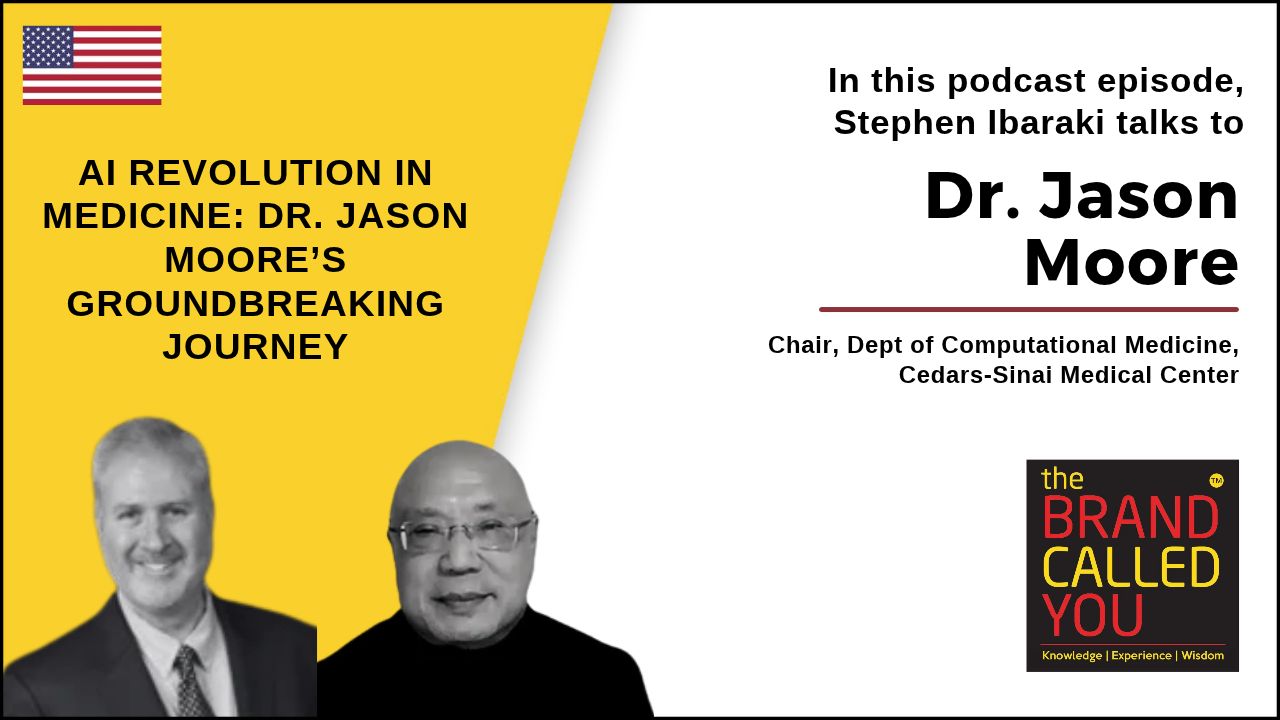
Dr. Jason Moore, Chair of Computational Medicine at Cedars-Sinai
- His lifelong fascination with biology and computation.
- The influence of early home computers, including the Atari 800, and programming languages such as BASIC and Assembly.
Podcast
Podcast: Play in new window | Download
Follow TBCY RSS
Overview
In this insightful episode of The Brand Called You (TBCY), Dr. Jason Moore, Chair of the Department of Computational Medicine at Cedars-Sinai, shares his remarkable journey from an early interest in biology and computers to leading pioneering research in biomedical AI.
The conversation explores his formative experiences, career-defining milestones, open-source innovations, and forward-looking perspectives on the role of agentic AI in healthcare.
Explore the key moments and topics discussed in this episode through the following timestamps and guiding questions.
02:21 – What Shaped Dr. Jason Moore’s Early Interest in Science and Technology?
- His lifelong fascination with biology and computation.
- The influence of early home computers, including the Atari 800, and programming languages such as BASIC and Assembly.
- The impact of key mentors, including his father, a clinical psychologist, and his high school biology teacher.
- The connections between programming and biology throughout his education.
09:14 – How Did Undergraduate and Graduate Training Prepare Dr. Moore for a Unique Career?
- Hands-on molecular biology research at Florida State University.
- Research in cancer genetics at the University of Michigan.
- Pursuing a PhD in human genetics alongside a master’s degree in statistics.
- Exposure to complex systems, nonlinear dynamics, and artificial intelligence.
- Building a strong quantitative and interdisciplinary foundation for his career.
15:14 – What Foundational Innovations Did Dr. Moore Lead at Vanderbilt and Dartmouth?
- Advancing rapidly into tenured academic positions without completing a postdoctoral fellowship.
- Directing and expanding high-performance computing (HPC) infrastructure.
- Pioneering machine learning methods, including the MDR algorithm, to identify gene–gene and gene–environment interactions.
- Building graduate programs and interdisciplinary research institutes.
- Training students and expanding bioinformatics resources.
22:09 – How Did Dr. Moore Help Democratize AI at the University of Pennsylvania?
- Taking on senior informatics roles and leadership responsibilities at the Penn Institute for Biomedical Informatics.
- Co-creating TPOT, an open-source automated machine learning (AutoML) platform.
- Developing reproducible benchmarking tools and no-code AI assistants, including Aliro.
- Leading the Biomedical Informatics Roundtable Podcast and the AI for Learning Health Systems Symposium.
25:01 – What Makes Cedars-Sinai’s Computational Medicine and AI Initiatives Unique?
- Building a new computational medicine department from the ground up.
- Establishing a Health AI PhD program embedded within a hospital setting.
- Founding Cedars-Sinai’s AI Council, directing CARE, and contributing to national AI campus initiatives.
- Advancing patient-centered AI and integrating AI into clinical research.
32:12 – How Is Dr. Moore Advancing Knowledge-Augmented and Agentic AI for Biomedicine?
- Developing agentic AI tools, including Kragan, Escargot, and EcoXAI, for intelligent knowledge-graph exploration and autonomous research.
- Examining the limitations of large language models that lack domain-specific knowledge integration.
- Open-sourcing biomedical knowledge graphs and agentic AI platforms, including ASARI for agent experimentation.
- Exploring explainability, reproducibility, and the potential of autonomous data science.
39:10 – What Are Dr. Moore’s Views on Open-Weight Models and Responsible AI in Healthcare?
- Evaluating and benchmarking open-source AI models from around the world.
- Exploring more sustainable AI approaches using smaller models that can run locally on systems such as NVIDIA DGX and Mac Studio.
- Emphasizing transparency, control, privacy, and the importance of open-source solutions in clinical settings.
47:16 – How Does Dr. Moore Apply AI to Disease Research, and What Are the Latest Developments?
- Using agentic AI to suggest potential drug-repurposing candidates for Alzheimer’s disease.
- Combining machine learning, biomedical knowledge graphs, and autonomous hypothesis generation.
- Exploring the potential of maraviroc, an HIV medication, as a candidate for Alzheimer’s disease following AI-assisted discovery.
- Collaborating with regenerative medicine researchers and using organoid models at Cedars-Sinai.
RESOURCES
Learn more about Dr. Jason Moore on LinkedIn.
ENJOYED THIS PODCAST?
One of Dr. Moore’s strategic career decisions was to move directly into a faculty position rather than pursue a postdoctoral fellowship. He also co-developed MDR, a groundbreaking method for identifying gene–gene and gene–environment interactions that traditional approaches often struggled to detect. This innovation helped open new avenues for understanding complex diseases.
Share your thoughts in the comments and help spread these insights throughout your network.
Would you love to give us 5 stars? ⭐⭐⭐⭐⭐ If yes, we’d greatly appreciate your review. Help us reach more people as we bring conversations with leaders, high achievers, and thought leaders from diverse backgrounds and nationalities. Excellence can come from anywhere. Stay informed and hear from emerging achievers and experts from around the world.
Stay updated with what’s shaping the world today through the latest The Brand Called You Podcast episode. Follow us on iTunes, Spotify, and Anchor.fm.
You can find us at:
Website: www.tbcy.in
Instagram: http://bit.ly/3HO7N06
Facebook:http://bit.ly/3YzJOaD
Twitter: http://bit.ly/3wMBOXK
LinkedIn: https://www.linkedin.com/company/tbcy/
YouTube: http://bit.ly/3jmBqfq
Chingari: https://chingari.io/tbcypodcast
Josh: http://bit.ly/3WWP0nB
Thanks for listening!
Profile
-
Dr. Jason Moore is Chair of the Department of Computational Medicine at Cedars-Sinai.
-
Combines his early interests in biology and computers to advance biomedical research.
-
Focuses on pioneering AI applications in healthcare, including open-source innovations.

