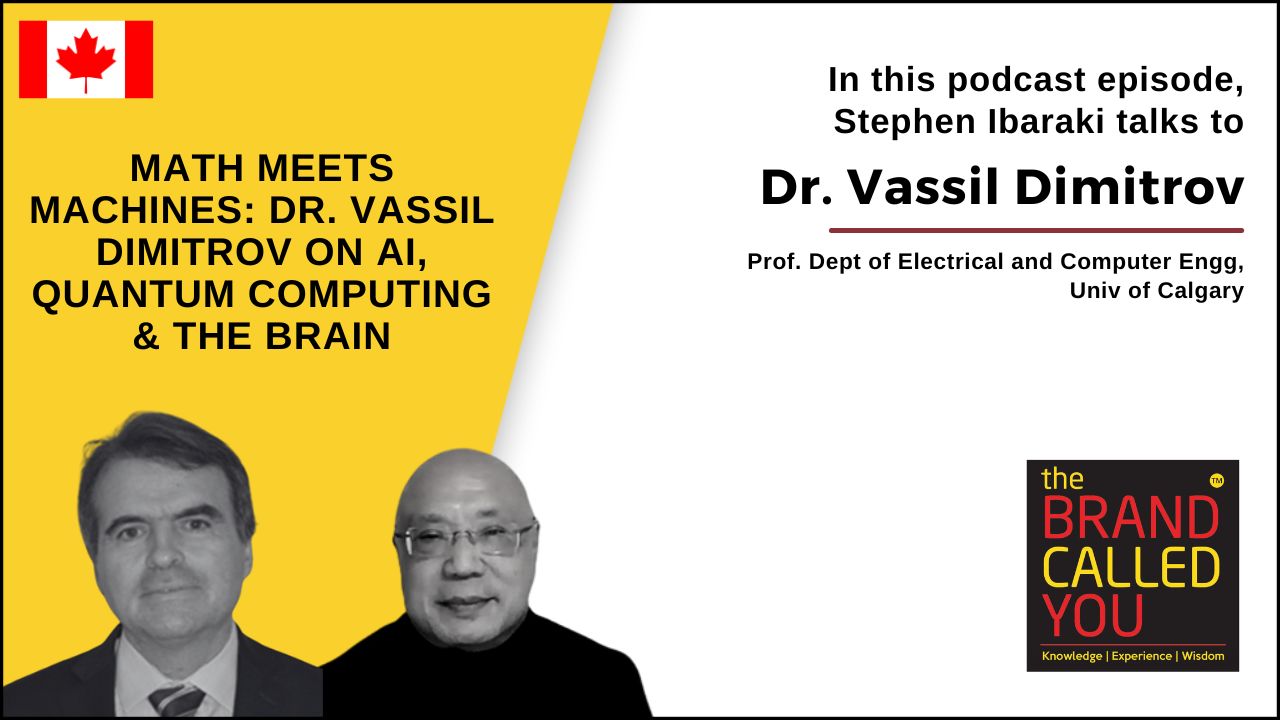
Dr. Vassil Dimitrov, Professor of Electrical & Computer Engineering, University of Calgary
- Lifelong curiosity and passion for mathematics
- Bridging mathematics and engineering through hybrid education
Podcast
Podcast: Play in new window | Download
Follow TBCY RSS
Overview
In this fascinating episode of The Brand Called You (TBCY), host Stephen Ibaraki interviews Dr. Vassil Dimitrov, Professor in the Department of Electrical and Computer Engineering at the University of Calgary.
Dr. Dimitrov shares his career milestones, deep passion for mathematics, and groundbreaking work at the intersection of encryption, analog computing, artificial intelligence, quantum computing, and brain-inspired hardware. The conversation explores how mathematics and engineering together are shaping the future of computation, AI hardware accelerators, image compression, and education.
Below is a detailed, timestamped breakdown of the discussion, highlighting key insights from each segment.
00:00:25 – Career Milestones
- Lifelong curiosity and passion for mathematics
- Bridging mathematics and engineering through hybrid education
- Commitment to applying mathematical theory to real-world problems
00:02:56 – Key Applications of His Work
- Advances in encryption and cryptography
- Research on information representation: analog vs. digital processing
- Inventing multiple-base number systems (used in hearing aids, now explored for AI hardware)
- Contributions to image compression and blockchain consensus algorithms
00:08:52 – Mathematical Problems That Fascinate Him
- Efficient factoring algorithms beyond conventional quantum methods
- Work on number-representation conjectures, including the Erdős conjecture
- Interest in problems that are simple to state but difficult to solve
00:11:55 – The Future of Quantum Computing
- Healthy skepticism about near-term commercial viability
- Insights into IBM, Google, D-Wave, and post-quantum cryptography
00:16:01 – Exascale Supercomputing
- Enthusiasm for exascale systems approaching brain-level operations
- Applications in genetics, drug discovery, physics, and protein folding
00:18:19 – Chip Architecture Breakthroughs
- In-memory computing as a major driver of future performance
- Physical limits of transistor scaling and the need for new architectures
00:20:05 – Photonic & Optical Computing
- Revival of optical computing for AI workloads
- Advocacy for hybrid optical-digital systems
RESOURCES:
Learn more about Dr Vassil Dimitrov: LinkedIn
Enjoyed this podcast?
Dr. Vassil Dimitrov is fascinated by how humans represent information. Why do many children answer “3” when asked what lies halfway between 1 and 9? Our brains don’t compute like machines—perhaps they use logarithmic encoding. Share your thoughts in the comments and spread these insights with friends!
Would you love to give us 5 stars? ⭐⭐⭐⭐⭐ If yes, we’d greatly appreciate your review. Help us reach more people to keep them in the know as we talk to leaders, high achievers, and thought leaders from diverse backgrounds and nationalities. Excellence can come from anywhere. Stay in the know, and hear from emergent high achievers and experts.
Stay updated with what’s shaping the world today through the latest The Brand Called You Podcast episode. Follow us on iTunes, Spotify, and Anchor.fm.
You can find us at:
Website: www.tbcy.in
Instagram: http://bit.ly/3HO7N06
Facebook:http://bit.ly/3YzJOaD
Twitter: http://bit.ly/3wMBOXK
LinkedIn: https://www.linkedin.com/company/tbcy/
YouTube: http://bit.ly/3jmBqfq
Chingari: https://chingari.io/tbcypodcast
Josh: http://bit.ly/3WWP0nB
Thanks for listening!
Profile
- Is the human brain analog, digital, or hybrid?
- Why analog computing may outperform digital systems for certain problems
- The real future of quantum computing: hype vs. reality
- Exascale supercomputers and their comparison to the human brain
- Image compression, blockchain algorithms, and AI hardware accelerators
- Advice for young researchers and innovators

