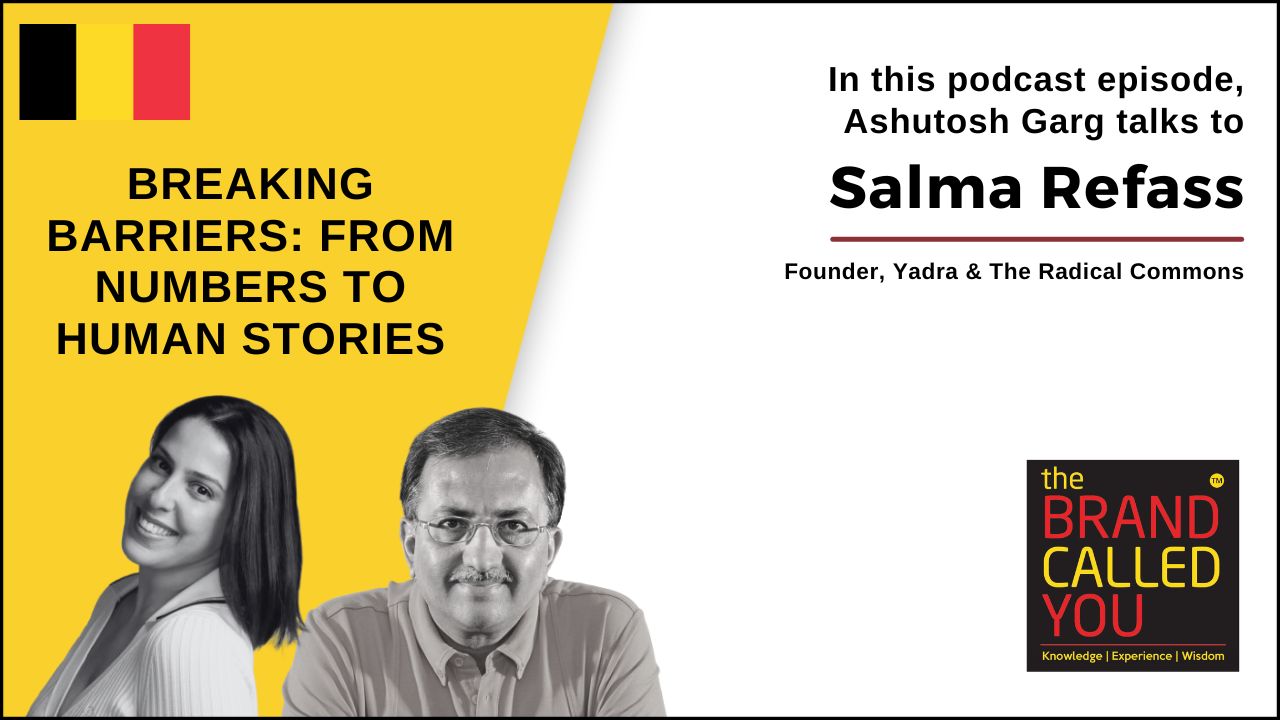
Salma Refass, Founder of Yadra & The Radical Commons
- The profound impact of witnessing the 2008 economic crisis as an economics student.
- Observing the failures of traditional economic models to explain real-world crises.
Podcast
Podcast: Play in new window | Download
Follow TBCY RSS
Overview
In this compelling episode of “The Brand Called You,” host Ashutosh Garg engages in a deep-dive conversation with Salma Refass — researcher, artist, and educator — about challenging economic orthodoxies, making knowledge public, and rethinking how policy is designed for the real world.
Here’s what you’ll discover:
00:50 | What early experiences led Salma Refass to question the value-neutral framing of economics during her training?
- The profound impact of witnessing the 2008 economic crisis as an economics student.
- Observing the failures of traditional economic models to explain real-world crises.
- The realization that ideological assumptions are often presented as “neutral” in economic education.
02:33 | Was there a specific moment when Salma Refass realized numbers alone could not capture social realities?
- Personal stories from Madrid during the European sovereign debt crisis.
- The disconnect between statistics (GDP, layoffs) and the visible human impact, including rising homelessness.
- A critique of the overreliance on numbers and the selective stories they can tell.
05:12 | What does “extractive policy” look like in practice, and how does it affect citizens?
- Citizens being treated as data points rather than political subjects.
- Participation often being superficial, where data is extracted under the guise of public input.
- The role of consultants and intermediaries in filtering and predetermining outcomes.
10:53 | Why does Salma Refass criticize the consulting-driven approach to policymaking?
- The dominance of the “consulting industrial complex” in public policy.
- Policy research becoming bureaucratic and disconnected from real impact.
- The gap between public engagement rhetoric and actual citizen involvement.
- The need to shift power: who defines problems, and whose knowledge counts.
10:56 | Why is complexity often used as a gatekeeping tool in policy and knowledge sharing?
- Jargon and complexity are often used to protect professional authority.
- Complexity narrows participation and fosters political exclusion.
- The importance of making public knowledge accessible — not oversimplified.
12:08 | What inspired Salma Refass to launch the “Public Segment” podcast?
- The realization that access to knowledge — not the absence of it — is the real gap.
- The podcast’s aim: translating deep research into accessible discussions for public engagement.
- Radical Commons as a platform to nurture alternative knowledge and solidarity.
14:04 | How does Salma Refass define “Radical Commons,” and why is imagination important for social change?
- The power of imagination to make alternative futures possible.
- How dominant capitalist realism limits our ability to envision systemic change.
- Radical Commons as a space for nurturing alternative ways of living and organizing.
15:54 | How does dominant economic thinking restrict our ability to imagine alternative futures?
- The naturalization of markets and rationality as “givens.”
- Questioning markets’ inevitability and exploring values like reciprocity, care, and solidarity.
- The call to democratize economics and bring these conversations to everyone.
RESOURCES:
Learn more about Salma Refass: LinkedIn
Enjoyed this podcast?
Why is “complexity” used as a gatekeeping tool? It’s simple: the idea that “only experts” can understand keeps circles tight, protects authority, and excludes the public — depoliticizing people who are told issues are “too complex” for them.
Share your thoughts in the comments and help spread these insights within your network.
Would you love to give us 5 stars? ⭐⭐⭐⭐⭐ If yes, we’d greatly appreciate your review. Help us reach more people to keep them in the know as we talk to leaders, high achievers, and thought leaders from diverse backgrounds and nationalities. Excellence can come from anywhere. Stay in the know, and hear from emergent high achievers and experts.
Stay updated with what’s shaping the world today through the latest The Brand Called You Podcast episode. Follow us on iTunes, Spotify, and Anchor.fm.
You can find us at:
Website: www.tbcy.in
Instagram: http://bit.ly/3HO7N06
Facebook:http://bit.ly/3YzJOaD
Twitter: http://bit.ly/3wMBOXK
LinkedIn: https://www.linkedin.com/company/tbcy/
YouTube: http://bit.ly/3jmBqfq
Chingari: https://chingari.io/tbcypodcast
Josh: http://bit.ly/3WWP0nB
Thanks for listening!
Profile
- The profound impact of witnessing the 2008 economic crisis as an economics student.
- Observing the failures of traditional economic models to explain real-world crises.
- The realization that ideological assumptions are often presented as “neutral” in economic education.

