
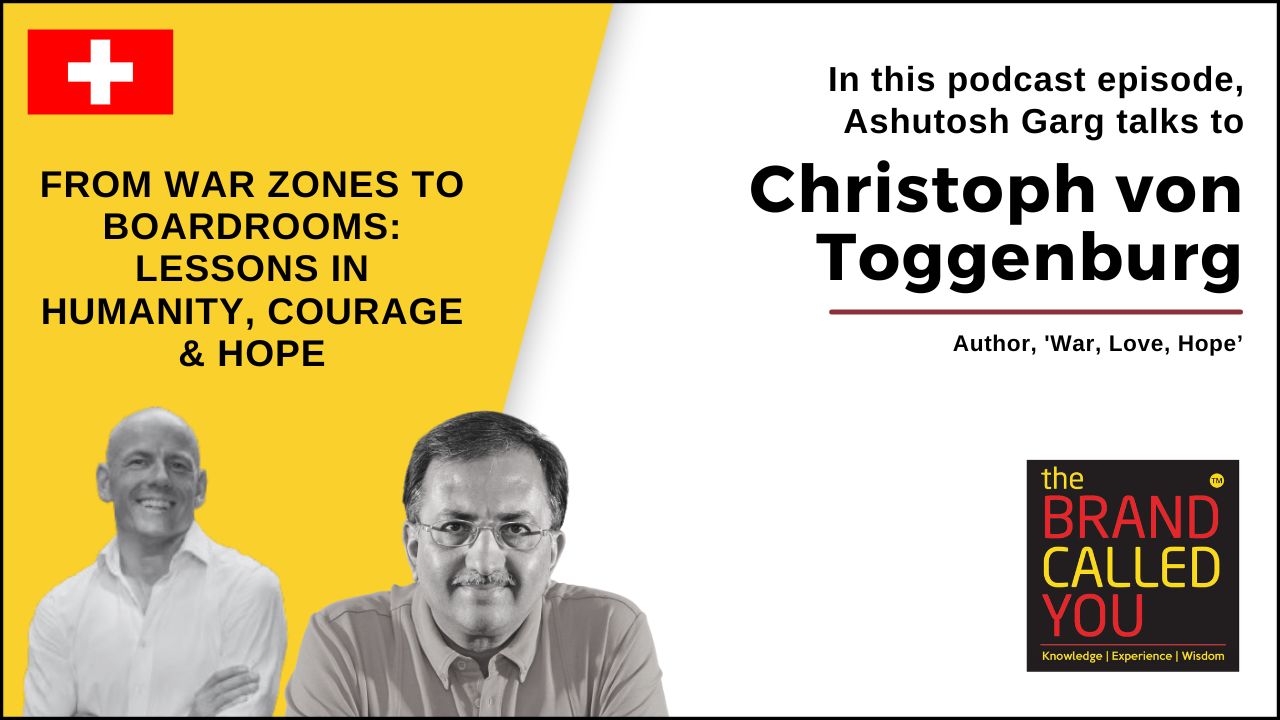
Christoph von Toggenburg, Global Impact Executive & Author, on Humanity from the Frontlines
- Giving a voice to the voiceless
- A consistent commitment to improving people’s lives, from war zones to boardrooms
Podcast
Podcast: Play in new window | Download
Follow TBCY RSS
Overview
In this insightful episode of The Brand Called You, we explore the extraordinary life and work of Christoph von Toggenburg, author, humanitarian diplomat, and global impact executive. The conversation delves into his experiences in war zones, the power of dialogue, leadership lessons, and the human capacity for resilience and hope.
01:06 – What is the defining thread connecting such diverse experiences?
- Giving a voice to the voiceless
- A consistent commitment to improving people’s lives, from war zones to boardrooms
- A focus on shining a light where none exists
02:09 – How did repeated exposure to violence change your understanding of humanity and yourself?
- A firsthand account of surviving an attack and experiencing PTSD
- The realization that the deepest humanity can often be found in the darkest places
- The importance of open dialogue with all parties, including those labeled as “terrorists”
- A commitment to avoiding judgment while prioritizing the protection of human lives
05:44 – Why use War, Love, Hope as the title of your book—and why that order?
- War was his professional environment for a decade, experienced from the perspective of a privileged outsider
- Love and solidarity emerged amid conflict and adversity
- Hope is presented as a choice and a vital force, even in moments of desperation
07:04 – What do you want readers to understand that headlines cannot convey?
- The book offers a deeply human perspective often missing from news coverage
- Personal stories reveal the individuals behind the numbers and statistics
- The book is ultimately an argument against war and in favour of dialogue
08:55 – Why is it vital to see humanity in those we fear, beyond heroes and villains?
- Dialogue becomes possible when we see and are seen as human beings
- Dehumanization and polarization erode empathy and understanding
- Humanizing those we perceive as opponents can create opportunities for connection and meaningful dialogue
10:28 – How do you learn to negotiate with people capable of terrible violence?
- There is no formal negotiation training; the emphasis is on simply showing up and engaging
- Meeting rebels on their terms, including travelling into the jungle to meet them
- Persistence and personal engagement can open doors to dialogue and agreements
- Finding common ground, even without complete agreement
12:31 – What surprised you most about the resilience of ordinary people?
- The powerful story of Leyla, who was kidnapped by Maoists, maintained hope, and later taught her captors karate
- Her remarkable happiness and resilience after being released
14:43 – What have war zones taught you about decision-making that boardrooms have not?
- War zones demand urgency and agility in decision-making
- Boardrooms can sometimes lack that same sense of immediacy
- The importance of purpose, social responsibility, and experiential learning for leaders
- The value of trusting one’s instincts when analysis must give way to action
17:48 – How would you define courage after your experiences?
- Courage means standing up for the unheard and the unpopular
- Choosing love and empathy, particularly in the face of extremist or divisive voices
18:52 – What emotional burdens do humanitarian workers bring home?
- Invisible wounds such as PTSD can affect humanitarian workers long after they leave conflict zones
- Difficulty reintegrating into peaceful societies
- A deeper appreciation for stability, security, and life itself
21:32 – How do resilience, purpose, and stakeholder capitalism change after experiencing conflict?
- Conflict can recalibrate what truly matters
- A warning against leaders who use polarization to gain power
- The “Bike for Help” journey demonstrates how grassroots action can create positive change
- Experiential learning can shape more responsible and purposeful leadership
RESOURCES:
Learn more about Christoph von Toggenburg: LinkedIn
Enjoyed This Podcast?
There is more to conflict than numbers. Human moments—such as a rebel commander asking for hair conditioner—reveal the complexity, humanity, and even unexpected humour that news reports often cannot capture.
Every number represents a person. Every person has a story.
Share your thoughts in the comments and help spread these insights across your network.
Would you love to give us 5 stars? ⭐⭐⭐⭐⭐ If yes, we’d greatly appreciate your review. Help us reach more people as we bring conversations with leaders, high achievers, and thought leaders from diverse backgrounds and nationalities. Excellence can come from anywhere. Stay informed and hear from emerging achievers and experts from around the world.
Stay updated with what’s shaping the world today through the latest The Brand Called You Podcast episode. Follow us on iTunes, Spotify, and Anchor.fm.
You can find us at:
Website: www.tbcy.in
Instagram: http://bit.ly/3HO7N06
Facebook:http://bit.ly/3YzJOaD
Twitter: http://bit.ly/3wMBOXK
LinkedIn: https://www.linkedin.com/company/tbcy/
YouTube: http://bit.ly/3jmBqfq
Chingari: https://chingari.io/tbcypodcast
Josh: http://bit.ly/3WWP0nB
Thanks for listening!
Profile
- Christoph von Toggenburg is an author, humanitarian diplomat, and global impact executive with extensive experience in complex humanitarian environments.
- His career has taken him into war zones and crisis settings, where he has worked to support people facing conflict and adversity.
- He emphasizes the power of dialogue, empathy, and inclusive leadership in overcoming divisions and building lasting solutions.

