
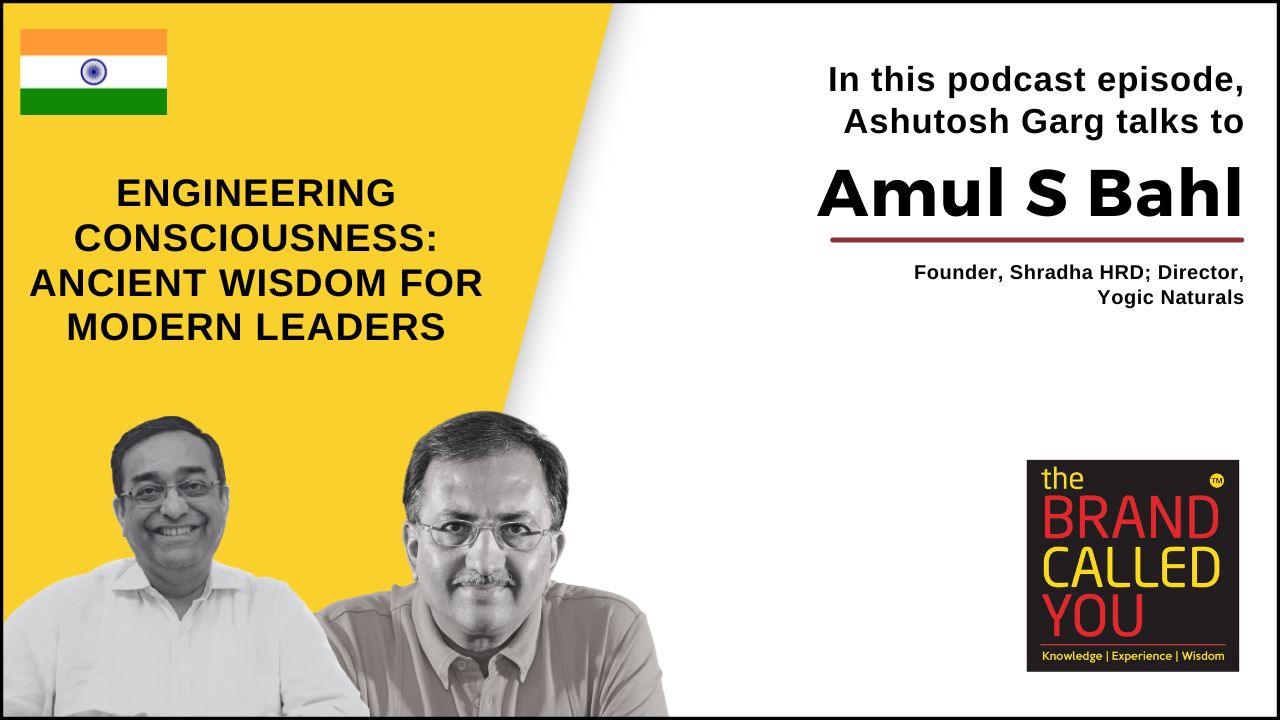
Amul S. Bahl, Founder, Shraddha HRD & Director, Yogic Naturals
- The importance of taking initiative rather than waiting for external support.
- The analogy of “wearing slippers instead of carpeting the earth.”
Podcast
Podcast: Play in new window | Download
Follow TBCY RSS
Overview
In this engaging episode of The Brand Called You, host Ashutosh Garg speaks with Amul S. Bahl, an accomplished leader in HR and wellness, known for integrating Vedantic principles into business leadership and culture-building.
The conversation explores defining moments in entrepreneurship, frameworks for creating high-performance cultures, the relevance of ancient Indian wisdom for modern CEOs, and the deeper messages behind Amul Bahl’s published works.
From understanding consciousness and human temperament to overcoming ego and building authentic leadership, this episode offers practical and philosophical insights for professionals, entrepreneurs, and business leaders.
00:49 | What was the turning point that inspired the journey into entrepreneurship?
- The importance of taking initiative rather than waiting for external support.
- The analogy of “wearing slippers instead of carpeting the earth.”
- Lord Ravana’s ten heads and twenty hands as a metaphor for using one’s abilities productively.
- The founding of Shraddha HRD to address the gap between being qualified and being truly capable.
03:32 | How does an engineer transition into studying consciousness and human development?
- The connection between engineering problem-solving and the study of consciousness.
- Understanding root causes as a common approach in engineering and consciousness work.
- The importance of making choices beyond basic desires and impulses.
05:21 | What gave Amul Bahl the confidence to introduce Vedantic principles into the workplace?
- Viewing Vedanta as a practical tool for everyday problem-solving rather than an esoteric philosophy.
- Understanding human nature through the analogy of understanding ingredients while cooking.
- Using inner exploration to support outward success, innovation, wellness, and product development.
07:51 | What is the framework for creating a high-performance culture?
- The role of self-aware leadership rooted in consciousness rather than ego.
- The importance of genuinely internalizing leadership principles.
- Using Vedantic concepts such as sattva, rajas, and tamas to understand people and align them with appropriate roles.
- Recognizing the contribution of every role within an organization, much like the organs of a human body.
11:04 | What remains constant about human behavior amid technological change and AI?
- The enduring question, “What’s in it for me?”, as a fundamental human motivator.
- The continued importance of personal connection and relevance in training.
- Why the fundamentals of human learning remain relevant despite advances in technology.
13:09 | How can business leaders understand and apply the concept of consciousness?
- The petrol-in-a-car analogy: consciousness is essential and neutral, but does not determine the direction of the journey.
- Tapping into consciousness to support continuous growth and expand leadership competence.
- How inward awareness can contribute to outward success and effectiveness.
16:04 | What can CEOs learn from ancient Indian wisdom that isn’t taught in business schools?
- Understanding the ego and the dangers of seeking external validation.
- The paradox that trying to appear unique through ego can ultimately make leaders more ordinary.
- The importance of sustained competence, humility, and moving beyond ego.
- Three manifestations of ego: “I am supreme,” “I alone exist,” and “I am the doer.”
19:32 | What are the core lessons from Driving Fundamentals, Living Essentials?
- The story behind the book, inspired by a near-accident and subsequent reflections on life.
- Prioritizing the engine over outward appearance, using the rearview mirror only when necessary, and focusing on the light ahead.
- Applying these driving metaphors to uncertainty and decision-making in professional life.
21:57 | What deeper message is offered in Rahasya of the Hanuman Chalisa?
- The idea that power already exists within us and can be rediscovered.
- Viewing the Hanuman Chalisa as a reminder of inner strength rather than simply a source of external help.
- Building self-motivation and resilience by recognizing one’s own inner potential.
24:17 | What is the single idea listeners should take away?
- The acronym CLASS: Consciousness, Love, Acceptance, and the well-being of all.
- The importance of inner transformation as a pathway to collective well-being.
RESOURCES
Learn more about Amul S. Bahl:
LinkedIn
ENJOYED THIS PODCAST?
The conversation explored the symbolism of Lord Ravana’s ten heads and twenty hands: when our skills and abilities are used productively, they can create something valuable for humanity; when left misdirected, those same abilities can become a burden.
What are your thoughts? Share your perspective in the comments and help spread these insights across your network.
Would you love to give us 5 stars? ⭐⭐⭐⭐⭐ If yes, we’d greatly appreciate your review. Help us reach more people as we bring conversations with leaders, high achievers, and thought leaders from diverse backgrounds and nationalities. Excellence can come from anywhere. Stay informed and hear from emerging achievers and experts from around the world.
Stay updated with what’s shaping the world today through the latest The Brand Called You Podcast episode. Follow us on iTunes, Spotify, and Anchor.fm.
You can find us at:
Website: www.tbcy.in
Instagram: http://bit.ly/3HO7N06
Facebook:http://bit.ly/3YzJOaD
Twitter: http://bit.ly/3wMBOXK
LinkedIn: https://www.linkedin.com/company/tbcy/
YouTube: http://bit.ly/3jmBqfq
Chingari: https://chingari.io/tbcypodcast
Josh: http://bit.ly/3WWP0nB
Thanks for listening!
Profile
- Amul S. Bahl is an accomplished HR and wellness leader who integrates Vedantic principles into modern business leadership and organizational culture.
- He explores entrepreneurship, high-performance cultures, and authentic leadership, helping leaders navigate complex professional challenges.
- His work connects ancient Indian wisdom with contemporary leadership, focusing on consciousness, human temperament, and overcoming ego.

