
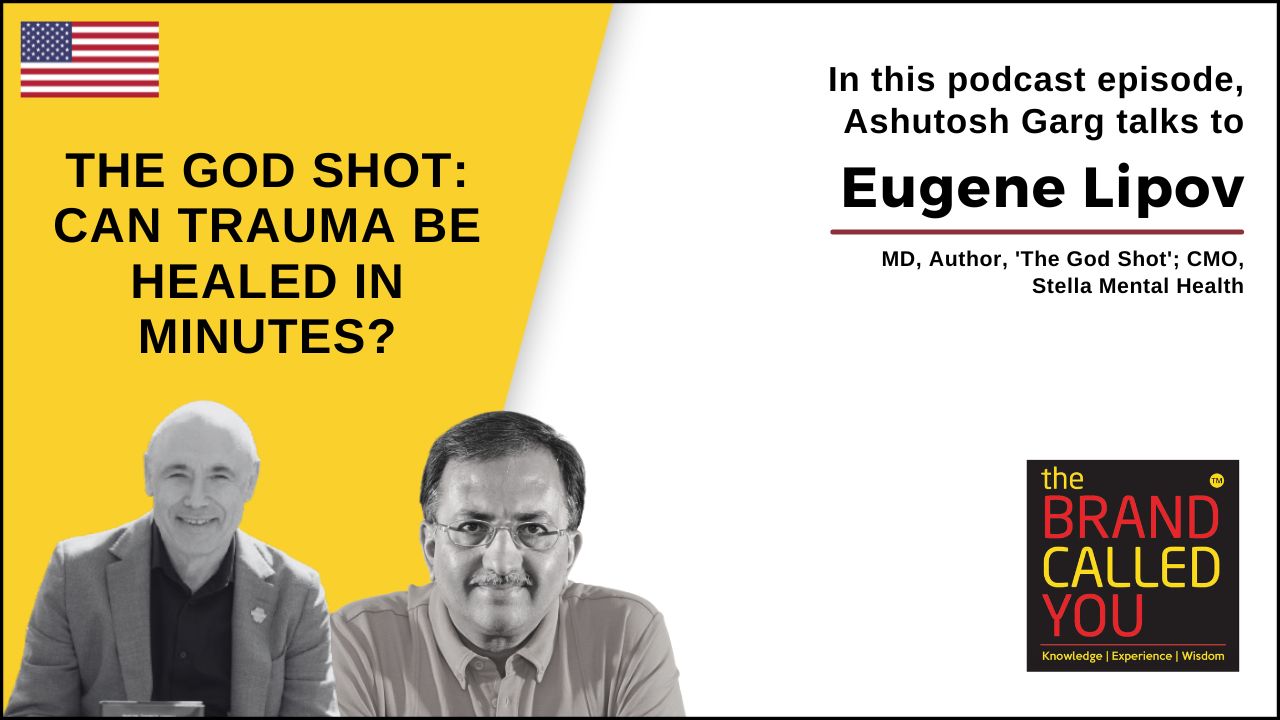
Dr. Eugene Lipov, Chief Medical Officer at Stella Mental Health
- Inspired by physician parents and his father’s severe PTSD from World War II
- Personal tragedy: his mother’s suicide due to secondary PTSD
Podcast
Podcast: Play in new window | Download
Follow TBCY RSS
Overview
Ever wondered if everything you thought you knew about trauma could be wrong? In this enlightening episode of The Brand Called You, Ashutosh Garg sits down with Dr. Eugene Lipov—Chief Medical Officer at Stella Mental Health and author of The God Shot—to unravel myths surrounding trauma and PTSD, explore groundbreaking treatment approaches, and share deeply personal stories of hope and healing.
00:00:51 — How Did Family Trauma Shape Dr. Lipov’s Medical Journey?
- Inspired by physician parents and his father’s severe PTSD from World War II
- Personal tragedy: his mother’s suicide due to secondary PTSD
- Shift from surgery to anesthesia, leading to a focus on trauma and pain management
00:01:38 — What Barriers Did Dr. Lipov Face in Challenging PTSD Norms?
- Introducing a novel pain procedure for PTSD was met with skepticism
- Faced disbelief and criticism, including scrutiny from the U.S. Congress
- Emphasized that “the proof is in the pudding,” now supported by replicated studies with promising results
00:03:15 — What Do People Most Misunderstand About Trauma?
- Trauma is a biological brain injury, not a character flaw
- The term PTSD is stigmatizing; Dr. Lipov advocates for “PTSI” (Post-Traumatic Stress Injury)
- Trauma can be visualized using modern technology such as functional MRI
00:05:17 — What Is “The God Shot,” and What Does It Mean for Patients?
- Named by U.S. Marines to reflect its life-changing impact
- Originated from powerful patient experiences and media attention
00:06:19 — What Is SGB and How Does It Physiologically Work?
- Stellate Ganglion Block explained using simple, vivid analogies
- Trauma elevates norepinephrine and nerve growth factor; SGB helps reset these
- Uses a safe local anesthetic (bupivacaine); effects can last for years
00:08:45 — Can Trauma Truly Be Healed, or Only Managed?
- Story of a Vietnam veteran who reconnected emotionally with family after decades
- Critique of conventional treatments that rely on multiple medications with limited effectiveness
00:10:27 — Why Does the God Shot Work So Rapidly?
- Blocks excessive norepinephrine release, reducing anxiety within minutes
- Compared to the immediate numbness of a dental nerve block
00:11:36 — How Can Trauma Be Contagious?
- Secondary PTSD explained through real family cases, including Dr. Lipov’s own mother
- Mirror neuron science shows how trauma transfers emotionally, even to children
00:14:11 — What Do Animal Studies Reveal About Invisible Injuries?
- Dogs and rats exhibit PTSD symptoms similar to humans
- Animal research validates trauma as a physiological injury
RESOURCES:
Learn more about Eugene Lipov: LinkedIn
Enjoyed this podcast?
Eugene Lipov shares raw stories: Special Forces veterans sobbing—finally able to take a deep breath. A Vietnam vet reunited with his children after decades. Even a dog on Xanax, healed after the procedure. Share your thoughts in the comments and spread these insights with friends!
Would you love to give us 5 stars? ⭐⭐⭐⭐⭐ If yes, we’d greatly appreciate your review. Help us reach more people to keep them in the know as we talk to leaders, high achievers, and thought leaders from diverse backgrounds and nationalities. Excellence can come from anywhere. Stay in the know, and hear from emergent high achievers and experts.
Stay updated with what’s shaping the world today through the latest The Brand Called You Podcast episode. Follow us on iTunes, Spotify, and Anchor.fm.
You can find us at:
Website: www.tbcy.in
Instagram: http://bit.ly/3HO7N06
Facebook:http://bit.ly/3YzJOaD
Twitter: http://bit.ly/3wMBOXK
LinkedIn: https://www.linkedin.com/company/tbcy/
YouTube: http://bit.ly/3jmBqfq
Chingari: https://chingari.io/tbcypodcast
Josh: http://bit.ly/3WWP0nB
Thanks for listening!
Profile
- Inspired by physician parents and his father’s severe PTSD from World War II
- Personal tragedy: his mother’s suicide due to secondary PTSD
- Shift from surgery to anesthesia, leading to a focus on trauma and pain management

